
Sunday, November 25, 2012

What were the Crusades, and were they justified? 26 November, 2012. Feast of St.Sylvester, Ab. St. Peter of Alexandria, BpM

What were the Crusades, and were they justified? - by Bro. Peter Dimond (MHFM)

_______________________________________________

"This is Bro. Peter Dimond, ( www.vaticancatholic.com).   I want to talk about the First Crusade and the Battle of Antioch.

In our day the Crusades have been demonized as unjust acts of aggression by European Christians against Muslims.   However, an honest assessment of the issue tells a different story.

In this video, I want to focus on not only why the concept of the Crusades was justified, even if not every single act of every single Crusader was, but also some of the miracles and the more interesting events that occurred during the First Crusade.   So the first question is, what were the Crusades and what was the First Crusade?

The Crusades were a series of military campaigns by European Christians to Jerusalem with the goal of liberating the Holy City from Muslim domination.

Now, immediately the objection is frequently posed by liberals, that this was an unjust war of aggression because the European Christians were travelling out of their territory south to Jerusalem into Muslim territory to attack them.  I recently viewed a video by a raging liberal who was condemning the Crusades on that very basis.

This clip is from an episode of a show called "The Young Turk, " Feb 24, 2011 ... "The idea that the Crusades and the fight for Christendom against Islam is somehow an aggression on our part is absolutely anti-historical."  Radio host... "They amaze me, man. They do it every day. How is it anti-historical?  Have you ever read any history?  The Muslims didn't come up from Jerusalem and march up to Europe and attack Christendom.  No! The Christians marched down to Jerusalem to attack the Muslims!"

And this is obviously a slanted and distorted view of history, because what he's forgetting or failing to tell people, is that prior to the rise of Islam, Jerusalem as well as the surrounding Palestinian area and Egypt and Syria, were all Christian territories inside the Roman Empire.
They were Christian lands, but once the false religion of Islam was born and it began to spread and attack its surrounding areas and grow, it actually took possession of Jerusalem.

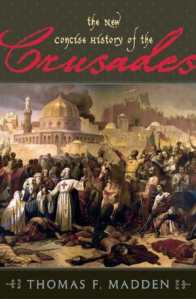
So the Muslims had actually launched the first strike by taking over what was a Christian city.  Technically, therefore, the Christians were onloy moving to recapture what was their city.  As historian, Thomas F. Madden, says on P.4 of his book, "The New Concise History of the Crusades," ..."like the Reconquista, the Crusades began as a result of a Muslim conquest of Christian territory."   In addition, Islam had showed itself to be a bellicose Empire, that was attempting to expand its boarders.   In fact, just a few years before Pope Urban II preached the First Crusade, Islamic Turks had captured the Byzantine Emperor at the Battle of Manzikert, and I want to quote from the "New Concise History of the Crusades" by Thomas F. Madden.

He says, "in 1071, Emperor Romanus IV ( the Byzantine Emperor) arrayed his forces against the Turkish assault on Asia Minor at the Battle of Manzikert.  The Turks destroyed the Byzantine armies and captured the Emperor.  Within a few years the citizens of Constantinople could look across the Bosphorus and see the land of the Turks."  And he goes on to say that the new Byzantine Emperor, Alexius I, asked the Western Christians for help against the expanding Islamic Empire.

Now, to put this in modern terms, and to refute the objection against the Crusade in a different way.  Suppose for a moment, that Iran attacked Israel in our day.

 If Iran were to attack Israel, undoubtedly, almost every voice in the mainstream media, would not only say that the U.S would be justified in sending its forces into the Middle East against Iran, but such a military campaign would be necessary.  They would justify it, and in fact demand it.  Yet we have a similar situation in the Crusading period.  We have the Muslims demonstrating aggression against the European Christians neighbour, the Byzantine Empire.

They recently captured the Byzantine Emperor and were threatening its boundaries in Asia Minor.  The Byzantine Emperor is asking the European Christians for help, and if the Byzantine Empire were to fall, it would pose a direct threat to Western Europe, unlike Iran, which poses no direct threat to the U.S. at all.

Yet, today's wisdom claims that the Crusaders were not justified in coming to the defence of the Byzantine Empire, while the U.S. would be required to come to the defence of Israel.   Some might say. "well, they not only came to the defence of the Byzantine Emperor, they also travelled further south.   And, of course, anyb war involves tactical strikes on the power base of the enemy.  The power base of the Muslims extended all through that region down to Jerusalem which had been a Christian city, therefore assaults up and down the area were justified in this war against two opposing empires

So, we have an expanding bellicose empire that has already conquered numerous Christian territories and was threatening the Byzantine Empire, and if they could take that, they were a direct threat to Westaern Europe.

It is also a fact that Christians who attempted pilgrimages to the holy city of Jerusalem, were being given a difficult time and many sacrileges were committed, and these were some of the things that Pope Urban II mentioned in his famous speech at the Council of Clermont in the year 1095, which kicked off the Crusading movement.

He said, "They ( the Muslim Turks) have invaded the land of those Christians and have depopulated them by the sword, pillage and fire.  They have led many away and part of the captives into their own country, and a part they have destroyed by cruel tortures."  And he goes on to mention some of the other things they were doing.

Council of Clermont
Therefore, with all these reasons in mind, that these lands had been Christian territories, that the Islamic Empire was posing a threat to the Byzantine Empire, and eventually to the Christian part of Europe, the military campaigns to weaken Islamic domination in the region and recapture Jeruslem, were absolutely justified, and that should be admitted even by those who do not favor the Christian cause.

In the face of the Islamic threat, Pope Urban II was outraged.  He called upon European knights and warriors to do something about it.  He inspired the Crusading movement by his speeches and organized an effort in which Christians would make a vow to travel to Jerusalem, to make a pilgrimage, but it would be an armed pilgrimage, because in order to fulfil their vow, and in order to reach the Holy City, they would undoubtedly have to fight their way through Islamic forces.

It was an oath taken to God, and the goal was the liberation of of the Holy City.  As Thomas F. Madden says, in his book. "The New Concise History of the Crusades," p.9 and p.10, published by Rowman and Littlefield, "Each Crusader joined the enterprise by taking a pilgrims vow.   During the taking of the Cross or "Crossing," a Crusader swore to make a pilgrimage to the Holy Sepulchre.  Because of the great expense and difficulties of such a journey, a Crusaders lands and properties were placed under the protection of the Church until his return.  A Crusaders vow was frequently accompanied by other vows of fasting or abstention from sex or by special devotions to be performed during the course of the pilgrimage."

Pope Urban II
The Crusaders were also granted indulgences, which are not permissions to commit sin or a pardon of future sin, rather a forgiveness of the temporal punishment due to already forgiven sins.  This brings us to another objection which claims that the Crusaders were not spiritually motivated, but were motivated by greed, they wanted to expand territories, they wanted to acquire wealth.

In this video, I am going to be quoting quite a bit from the book I just mentioned by Thomas F. Madden and a lot from another book by Thomas Asbridge, "The First Crusade," published by Oxford University Press.   Now, both authors are professional historians, secular historians.  Neither could be called a defender of the Catholic Church.   Asbridge especially, is humanistic and irreverent in his approach.  He puts miracles in quotes almost every time he makes reference to the word.  He doesn't even speak of the years after Christ as A.D. ( in the year of the Lord ), rather he prefers to use the secular humanist designation of C.E. referring to Common Era.

The point is, that he is not a Catholic, he is not an apologist, but he is forced to admit that the Crusaders were not motivated by greed primarily.  He says on p.68 of his book, "The First Crusade," ..."We know that greed cannot have been the dominant motive among the First Crusaders, not least because, as recent research has shown, for most participants the expedition promised to be utterly terrifying and cripplingly expensive."  He points out that they did not stand to gain wealth in many cases.  In many instances they were risking their wealth and their territories and their properties at home.  They were also risking death, of course.

On p.70 "the evidence for the aristocratic response to the Crusading message strongly suggests that spiritual concerns dominated the minds of Latin nobility as they took the Cross."

Preaching the First Crusade
The Crusading movement gained such widespread support almost immediately, because many in Europe were truly appalled by what the Muslims were doing to formerly Christian territories.  Asbridge points out on p.41 of his book, that contemporary historians of that period as well as historians of today were amazed by how many people took up the effort.  He says, "It was nonetheless a gathering of human force and resources on a scale unparalleled in this age.  Contemporary observers from within Europe and without gazed in wonder."

People also allege that some Crusaders unjustifiably murdered Jews along the way to Jerusalem,  "And, then, oh Jews. they killed how many thousands of Jews, massacres on their way into Jerusalem, and , of course, when they get to the Muslims, well, we came here to kill the Muslim, so that makes sense."

In response, I would say that in any army or military campaign, there will be examples of brutality, sin, murder, and / or immorality.  These do not necessarily reflect upon or relate to the worthiness of the campaign itself.   The question is did the campaign call for such acts?  And the answer is, in the case of the First Crusade, is NO.  There are bands of evil men in any large crowd.   Moreover, one can legitmately question whether the stories of murders have been exaggerated over the years along with the modern momentum to condemn the Crusaders and everything relating to them.

Many of these reports come from surviving Jewish eyewitnesses who would have an ax to grind in exaggerating of at least the extent of what really occurred.  So, even if one grants that unnecessary killings did occur along the way, they can be classified as individual acts of a few men in a large army.  These do not represent or comport with the purpose of the Crusade..  In fact, as we will see, since the Crusade was a loosely organized military force, one man was not responsible for the hostile actions of other parts of the army. 


Route of the First Crusade
The first move of the Crusades was to the east to meet up with the Byzantine Emperor.  He had requested the Crusaders assistance, but at the same time he was wary of them.  He was concerned that they might use their force to overrun Constantinople and take control of his Empire.  Thus, he wanted to use them but at the same time keep his distance from them.


He actually wound up abandoning the Crusaders when it looked like they were going to die and be crushed at Antioch, and that's what I want to talk about mainly, in this video is the great Battle of Antioch which historians will say was really the key to the entire First Crusade.

Before they got to Antioch, they had to make their way through Asia Minor and they engaged in numerous battles and endured hardships.  About half of their force actually died in Asia Minor either due to disease, death in battle or starvation.  But they eventually made their way to Antioch in Syria, which was one of the great cities of the East and of course was an ancient Christian city, and it had been captured by the Muslims in the year 1085.   That again points us back to why the First Crusade was justified, even if you do not favor the Christian cause. This was a city that was an ancient Christian city.

Antioch, in fact, was the place where the disciples of Christ were first called Christians as we read in Acts 11:26.   It's also interesting that the first term of the term Catholic that we have recorded, comes from St. Ignatius of Antioch, around the year 110A.D.   I find it very significant that the first use of the term Christian is associated with Antioch.  he Catholic Church is the original Christian Church. 


So, they approached the great city of Antioch which had been captured by the Muslims, and it was imperative for them to take Antioch, because there was no way that they could complete their pilgrimage all the way to Jerusalem, if this great city remained in enemy hands.  They could not keep keep their supply lines open-there's just no way they could pull it off.  the problem, however, was that Antioch was one of the most fortified cities in the world, and it would be a daunting and extremely dangerous task to attempt to take it.

On pages 158 and 159, Asbridge says, " The Crusades were deeply shocked and intimidated by their first glimpse of the city.  Stephen of Ware (sp) noted in a letter to his wife... 'we found the city of Antioch very extensive, fortified with incredible strength and almost impregnable.  The city lies at the foot of two craggy mountains and until modern expansion was hemmed in to the west by the Orontes River.  In the 6th century these natural features were enhanced by a remarkable construction program, 5km in length, 2 metre thick and up to 20 metres in height."


The seige of Antioch
Realizing that it would be almost impossible to breach the walls of Antioch, they decided to starve the inhabitants of the city into submission.  They thus began a long and gruelling effort to cut off the cities supplies, however, in the process they began to starve themselves.  "The  winter of 1097-1098  was a particularly cold and difficult one.   40,000 people require a great deal of food and there was little to be had.  Foraging parties, already had exhausted nearby lands, so they were sent even further in search of provision.


Hunger, starvation and disease descended on the soldiers. Many knights who had not lost their horses during the gruelling journey, were forced to slaughter them for meat.  At that time, the famished ate the shoots of bean seeds growing in the fields and many kinds of herbs unseasoned with salt, also horses, asses and camels, and dogs and rats.  The poor ones ate even the skins of beasts and the seeds of grain found in manure. Many died of starvation and some even turned to cannibalism.

When they were about to despair outside the walls of Antioch, they got news that the larger Muslim army was coming to crush them.  This created a panic.  The situation was even more tenuous, because the way the Crusade had been arranged, there was no central military leader.  It was a loosely organised army of pilgrims who were allied with a few dominant princes.

Even though there were different factions surrounding Bohemond and Raymond, and other prominent leaders, no one leader could demand the obedience of everyone.  This complicated matters throughout the Crusade and made their eventual victory even more astonishing.   As they were at death's door outside the walls of Antioch, about to die of starvation or despair with a larger Muslim force coming, it was at this time that they saw signs which they interpreted as God's displeasure.

Asbridge says on p.175, " On top of all this, a series of natural phenomena, including a comet and an aurora, were experienced in Northern Syria and interpreted by the Crusaders as miraculous signs of God's displeasure.  One Frank recalled, 'that at the time we saw an astonishing glow in the sky, and in addition, we felt a great movement of the earth, which made us all quake.  Many saw a certain sign in the shape of a Cross, whitish in color advancing toward the East in a straight path,'

They concluded that God was punishing them for their sins, that their sins were the reason that God had not allowed them to achieve the submission and capture of Antioch.   Hence, they made an effort to purge the army of vices and grave sins.  Around this time, the Crusaders were forced to split up their forces, keeping some of their troops outside the wall of Antioch, and sending some of their troop on an expedition for food and related matters.

An expeditionary force of the Crusaders encountered a Muslim army that outnumbered them more than 12:1.   "The Crusaders were facing an immense challenge to repel some 12,000 Muslims with under 1000 troops of their own.  The shear imbalance of these forces makes one wonder whether the Frankish sources exaggerated the severity of their predicament, but for once even the Arabic sources confirm that the Aleppan army was numerically superior.

How then, could the Crusaders hope to prevail against such odds?  Looking back on the battle one Crusader argued that God had miraculously multiplied the number of Latinites from 700 to 2000 as the fighting began.   So, Behemond, protected on all sides by the Cross, charged the Turkish forces like a lion which has been starving for three or four days.   His attack was so fierce that the points of his banner were flying right over the heads of the Turks.  

The other troop seeing Bohemond's banner carried ahead so honorably, stopped the retreat at once, and all of our men in a body charged the Turks, who were amazed and took flight.   Our men pursued and massacred them right up to the Iron Bridge,'  Asbridge, "The First Crusade," p.185, and keep in mind he's not a Catholic historian, and he's describing this stunning victory.   The entire Crusade, it could be said, rested on the outcome of this battle.   And this was not a battle for Antioch itself, but a battle to survive outside the walls of Antioch, and this larger Muslim relief force was still coming.  

It's fascinating that these historians point out that Kerbogha, the Muslim leader, delayed coming to Antioch with his huge Muslim army, just long enough so that the Crusaders could get inside the city after they had taken control of it.   Thomas F. Madden says on p.28 of his book, "Instead of heading straight for Antioch, Kerbogha first stopped off at Edessa, in an unsuccessful attempt to wrest the city from Baldwin.   He was delayed there for three weeks, a crucial delay that allowed the Crusaders time to hold off in Antioch.   Had the Sultan not stopped he would have caught the Christians outside the walls of Antioch, just as they feared."

Spending many months outside the walls of Antioch, the Crusaders attempted to bribe some of the Muslim guards who were watching the walls in different parts of the city.  Eventually, they got a person inside Antioch to betray the Muslims, and to give the Crusaders access up one area of the formidable walls.  And it was an extremely tense situation, because they were risking lives going up the walls.  "A knight from Shard (?), named Fulcher, was the first to mount the wall, but now, in their panic desperation not to be caught in mid-climb, too many Crusaders rushed up the ladder, and overburdened, it toppled, killing some and injuring others." p.209. Asbridege's book.

So, basically, they got this Muslim, they paid him off, so he would allow them in the middle of the night, to climb up one area of the walls, but if they were discovered and the entire Muslim garrison within Antioch had been alerted, they could have been massacred as they were going up the walls, and they were moving so quickly, the ladder fell over and killed some of them."

"However," he continues," at last the remaining men reached the wall top and the most dangerous moment of the entire assault, speed and silence were essential, for had the general alarm been raised, the entire attack might have been thwarted.   Amazingly, the Crusaders managed to kill the patrolling watchman and the sleeping guards.'  He says, on the next page, "In those first crucial minutes, the combination of surprise, the confusion of darkness, and the fear of the Crusaders unrestrained brutality, paralysed the defenders.   According to one eyewitness, panicked by the sight of our troops on the overhanging hill, some of the Antiochians rushed through the gates, while others leapt from the walls.  The Lord threw them into such chaos that not a single one of them stood and fought."

The capture of Antioch
It was then a rout once they got their soldiers inside the city, and they killed almost everyone.  It was amazing how they were able to take the city and subdue it so effectively.  So after months of struggkle in an attempt to take the city of Antioch, they had finally been successful and were securely within its walls.   However, the very next day, the huge Muslim relief force under Kerbogha arrived, and now the Crusaders were being besieged by the Muslims outside the city, just as they had previously besieged the city.

You think that it's just a coincidence that the huge Muslim relief force which almost certainly would have crushed the Crusaders outside the wall, arrived only one day after the Crusaders were able to capture the city, and make their way inside the walls.   I don't think so.  I believe God arranged it, so that the Muslim relief force would not arrive until the Crusaders made their way into the city.   However, their situation now was even worse than it had been before.   As Asbridge points out on p.213, "After such a triumph, their ultimate nightmare had come to fruition, thousands of kilometres from home.   Already exhausted by months of battle and suffering, they were about to be surrounded by an overwhelming force from which there was seemingly no escape.   The Crusaders quickly decided they were in no position top meet this new threat in a full scale battle, as they had done with Radwan's army in February.
Kerbogha's force was much larger, outnumbering their own by as much as 2:1, and more importantly, the Crusaders themselves were now critically short of cavalry, having run out of horses."   Since most of the supplies within the city of Antioch had been depleted as a result of the Crusaders own effort to cut off the city from outside supplies, they were now starving.   Kerbogha's forces also gained control of a small part of the city, the citadel.

Surrounded, isolated, outnumbered and starving, the Crusaders army which had managed to gain control of Antioch, was now on the verge of collapse.   "On 11 June, another rumour spread throught the army suggesting that the princes themselves were preparing to flee towards the coast, and the Crusade leaders were able to calm their troops, only by each swearing an oath not to abandon Antioch.   One Crusader noted that even then, only the closing of the gates of Antioch by order of Bohemond and Adhemar, prevented wholesale evacuation."

As the Crusading army was about to collapse, they saw a sign, Asbridge says on p.219, "Then, on the night of the 13th and 14th June, with the Frankish resistance close to collapse, a strange light was seen in the heavens.  One of Bohemond's followers recalled, 'there appeared a fire in the sky coming from the west, and it approached and fell upon the Turkish army, to the great astonishment of our men and the Turks also.   In the morning, the Turks who were all scared by the fire took flight and panicked."

After their repositioning, the Muslims increased their stranglehold on the city and completely cut off the Crusaders.  The Crusaders were now truly suffering from starvation.   Our Frankish eyewitness recounted 'the blasphemous enemies of God keep us so closely shut up in the city of Antioch, that many of us died of hunger.   So terrible was the famine, that men boiled and ate the leaves of figs, vines, thistles and all kinds of trees.'   All the eyewitness sources indicate that total defeat seemed inevitable and imminent.

At this time a peasant named Peter Bartholomew, claimed that he had received visions about the location of the Holy Lance that had pierced the side of Christ.

After the alleged discovery of the Holy Lance, the armies morale was boosted and they were inspired to attack the much larger Muslim force.   Hans Mer, an authority on the Crusading movement, has written, "The immediate effects of the discovery of the Holy Lance were enormous.  The armys moral was raised, and all were united in the urgent determination to break the blockade and destroy Kerbogha." 

At this point the Muslim army, outside Antioch, beseiging the city, outnumbered the Crusaders 7:1.   The Crusaders were starving, yet inspired by the apparent discovery of the Holy Lance.  The combination of these two factors, persuaded them to launch a super aggressive and extremely dangerous strategy of breaking out of the city, and confronting the huge Muslim army which was seven times bigger, head on.

Even sceptical secular historians call the outcome of this battle miraculous and astounding.  The Crusaders prepared for their charge by three days of spiritual activity.  " On 28 June, 1098 they were ready to fight, and at first light they began marching out of the city, while clergy lining the walls offered prayers to God.   The Crusaders staked the fate of the entire expedition upon this desperate strategy, yet historians have only recently begun to provide a convincing explanation for the astounding outcome of the battle that followed."  Asbridge p.233

He also explains some of the dangers involved in their effort.  "What was needed now, was a General capable of adjusting his battle tactics to the tools at hand, and that Commander was Bohemond.  He faced a seemingly insurmountable task.   First, the Crusaders would have to break through  the Muslim cordon surrounding Antioch, and avoid being cut to pieces during what would inevitably be a painfully slow piecemeal deployment outside the city.   There was every possibility that the first wave of Crusaders might be stopped in its tracks, and decimated before the first weight of the Frankish army could even get out of the city.  Once arrayed on the plains of Antioch, they would then somehow, have to overcome the enemy." p.234.

However, their storm out of the city strategy worked.  The Muslim army that had been blockading the city panicked and began to flee.   As they retreated they ran into the larger Muslim force that was slowly advancing.  This threw the entire Muslim army into disarray and they fled.   Even a Muslim chronicler acknowledges, " The Franks, though they were in the extremity of weakness, advanced in battle order against the armies of Islam, which were at the height of their strength and numbers, and they broke the ranks of the Muslims and scattered their multitudes."  Asbridge p.238.  

Beginning of the Great Battle of Antioch

 Asbridge points out on p.239, "The significance of the Great Battle of Antioch cannot be overstressed.   It was without a doubt, the single most important military engagement of the entire expedition.   To contemporary writers, this achievement was so extraordinary, that it could only be explained as a miracle.  They argue that the Franks had been saved from certain defeat by only one thing, direct, palpaple intervention by the hand of God.

Numerous miracles were recorded.   Raymond recorded that, "in the beginning of the march out to battle, the Lord sent down upon all His army, a divine shower, little, but full of blessing.   All those touched by this were filled with all grace and fortitude, and despising the enemy, rode forth as if nourished on the delicacies of Kings.   This miracle affected our horses no less." 

An eyewitness who actually fought in the battle added, " there came out of the mountains, also, countless armies with white horses whose standards were all white.   And so, when our leaders saw this army, they were entirely ignorant as to what it was, and who they were, until they recognised the aid of Christ, whose leaders were St. George, Mercurius, and Dimetrius.   This is to be believed for many of our men saw it."

Secular historian, Asbridge also calls their victory seemingly miraculous on p.241 of his book.  This is from a man who uses C.E. Common Era, instead of A.D. in the year of the Lord, and puts the word miracle in quotes almost every time he uses it.  

Historian, Thomas F. Madden, on p.30 of his New Concise History of the Crusades, also acknowledges the seemingly miraculous intervention.   He says, " Against all odds, the Crusaders has won a smashing victory, but not alone.   Many of the combatants and those watching from the walls, attested to the presence of armies of angels and saints, as well as the spirits of fallen comrades, fighting alongside Bohemond's troops against the forces of Turks."


Presence of armies of angels and saints
One could say that the contemporary accounts of miraculous intervention were all fabricated by the Crusaders, however, even the most hardened sceptic and secular historian reports the fact that the Crusaders triumph at Antioch was stunning and defied all odds.

After the Crusaders had defeated the army outside of Antioch, they used the opportunity to rest and recuperate.    However, greed and ambition among the princes of the Crusade almost derailed the entire Crusading effort.   This speaks to a larger point.   In almost all efforts against evil, impure intentions thwart what would have been greater successes.   The conflict between doing God's will and doing one's own is a constant struggle, the outcome of which, often determines whether good or evil has the upper hand.   The effects of holy enterprises are almost always minimized by men who have deviated from the course God set out for them.

And, when such enterprises are successful, it's the result of men having overcome the temptation to serve themselves instead of God, or to serve themselves while serving God.

What occurred, was that one of the leaders of the Crusade, Bohemond, desperately wanted to retain possession of the city of Antioch, for himself as a prize.   Raymond of Toulouse, another leader, did not want to let him have it.   As a result the Crusade stalled.

Eventually, the general army threatened rebellion and abandonment if someone did not lead them to Jerusalem to fulfil their vow.  Raymond finally agreed, while Bohemond remained in Antioch.

It's also interesting that one of the visionaries, Peter Bartholomew, had allegedly received new visions, but these were considered so outrageous that he was compelled to submit to a trial by fire.   He prepared for the trial for four days, and then walked into a blazing inferno of branches.   According to one account he emerged unharmed, but he died two weeks later.

As the Crusading army made their way to Jerusalem, at least the portion that did not remain at Antioch and in other places, they liberated the territories along the way.   They freed Bethleham, the birth place of Jesus Christ as well as the Christians who had lived under Muslim domination there.
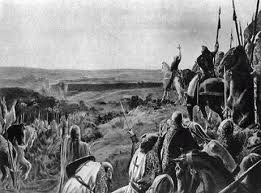

Crusaders first view of Jeruslem
But, as they moved towards Jerusalem, they became increasingly isolated and exposed, for they were deeper into Islamic territory, vulnerable to Muslim armies from North Africa, and further away from the base they had established.   "For close on three years the Crusaders had marched across the face of the known world, enduring terrible suffering to reach the most sacred Christian city on earth.  

Jerusalem, in their eyes was the centre of the cosmos, the city where Christ had lived, died, and been resurrected.   Many Crusaders believed that if only the earthly city of Jerusalem could be recaptured, it would become one with the Heavenly Jerusalem, a Christian paradise.

Not surprisingly, many wept openly when the long sought objective of their pilgrimage finally came into view on 7 June, 1099."

Asbridge continues on p.299, "With their nearest allies hundreds of kilometres distant, well aware that before long, the Fatimids would launch a massive counter attack, the Crusaders had still raced to Jerusalem.  It was a move of the utmost daring, at once expedient and visionary, knowing they lacked the manpower or resources to overcome all Palestine, the Franks chose to make a last ditch strike at its heart, but they would probably never have taken such an immense gamble if not possessed by pious conviction, a steadfast belief in the force of divine protection.

In the cold light of strategic reality, failure to secure the almost immediate capture of Jerusalem, would leave the stranded expedition, facing extermination."


Seige tower
Jerusalem was also protected by formidable walls and the Muslims had poisoned all the wells of water outside the city.   The Crusaders needed seige towers, and they lacked the material to build them.   They were now also suffering greatly from thirst.   "The worst water taken from filthy marshes reportedly contained leeches, which were often accidently swallowed by the poorest Crusaders, in their rush to gulp down what they could, causing an agonizing death."
Asbridge, p.304.    


At this time, ships from the Mediterranean had arrived near Jerusalem.   They contained the materials that would enable the Crusaders to construct seige towers to complete their assault on Jerusalem.   The Crusading princes squabbled over who would get to rule Jerusalem, but they eventually united, realizing that they needed complete unity and determination to avoid extermination.

The Muslims in Jerusalem saw the Christian army and taunted them.   They spat upon and urinated upon crosses, and the Crusaders yelled things back .

The manner in which the Crusaders army breached the walls of Jerusalem was quite interesting.  The Muslims in Jerusalem could see the Crusaders constructing a seige tower in a certain area of the city, so as a result, the Muslims beefed up their defences accordingly.   But, in the middle of the night, the Crusaders quickly disassembled the seige tower, moved it about a 1/2 mile to the east, and then assembled it there.  


Crusaders marching around the walls of Jerusalem
 What followed was a brutal battle, but the Crusaders strategy had worked.   They were able to use the recently moved seige tower to breach the walls at a point where the Muslim defence was weaker, while the Crusaders still had an army fighting off the Muslims, where their defence was stronger.    "Forced to defend the northern and southern walls, the Fatimid garrison stretched its resources to the breaking point."  Asbridge p.313.  Once the Crusaders breached the wall and entered the city, the Muslims defence collapsed, and it was a massacre.

Modern historians comment with horror upon what the Crusaders did to the inhabitants of Jerusalem.  Reports are that they killed and plundered everything they could.   While there is no need to defend every act of every Crusader, one must remember, that in times of war, inhabitants loyal to an enemy force, can be considered, on some level, enemy combatants.  Their existence within the city can pose a threat to one's security, and while there were certainly some excesses, one has to see the sacking of Jerusalem in that light.

The Crusaders also had just completed a deadly and difficult task of beseiging a large and well defended city.   They were exhausted and in battle mode.    Was it reasonable for them to trust the Muslim inhabitants of the city, or to believe that they posed no threat to their long term occupation of Jerusalem? 

In numerous places in the Old Testament, God commanded His people to eliminate everyone in a city they had just conquered.

After the sacking of Jerusalem, the Crusaders declared Godfrey ruler.   However, they had a new problem.  A large reserve Muslim army was coming to recapture Jerusalem.  The Fatimid Muslims had an army of about 20,000 coming toward the Crusaders, while the Crusaders had been reduced to about 10,000.   Outnumbered, the Crusaders decided they had to launch an aggressive surprise attack on the new Muslim army, and it worked.   They crushed the Muslims, driving many of them into the sea, causing others to flee into their forces.

The Muslim leader was "astonished at being so easily crushed by a force that Vizier had assumed would be a spent rabble."   Asbridge p.236.   With that victory, the Crusaders mission was complete.   The First Crusade was a miraculous success.   As Asbridge concedes, "With the victory of the battle of Ascalon, the main armies of the first Crusade reached the end of their journey.  Those that suvived, witnessed a "miracle".   The Holy City of Jerusalem had been recaptured against incalculable odds, and all the might of Islam had broken on the rock of Latin devotion.   Now, as summer waned, the thoughts of most turned to home."  p.237.

The Crusaders maintained control of the region for 200 years.   It's also very interesting, to note that late arrivals to the First Crusade, waves of warriors, who set out for Jerusalem well after the first army, never even made it out of Asia Minor.   As Thomas F. Madden points out in his book, "The New Concise History of the Crusades," p.41, "None of the other new arrivals of Crusaders met with any more success.   All of them were crushed in Asia Minor, before they could reach Antioch.    In the failure of these expeditions, the largest that Europe had launched, the astounding success of the first Crusade seemed even more miraculous."

Some Christians might ask, since God miraculously supported the First Crusade, enabling them to capture Jerusalem, and the region, why didn't He do the same with the later Crusade efforts?   I believe the answer is multi-faceted.    First, in order for evil to be eradicated and good to prevail, God often requires the co-operation of men.   The evidence indicates that the response to Pope Urban II's calls for the First Crusade was sincere and widespread.   While some Crusaders were, of course, selfish and ambitious, on the whole, this was a genuine effort of Christian Europe to put aside differences and unite for Christ against infidel.


Frederick II
As a result, the true God of the Christians showed His power, and gave the Crusaders a miraculous victory deep into Muslim territory.   Once God had shown His power, and the truth of the Christian religion, by enabling the Crusaders to miraculosly retake Jerusalem and the entire region, from the hands of the Muslims, God was not, thereafter, inclined to give miraculous victories to people who were so divided, selfish and sinful.

And, the fact is, the leaders of Europe were frequently divided, selfish and sinful.   As an example, one of the leaders of the later Crusade effort, Emperor Frederick II, had been excommunicated for consistently encroaching on the rights of the Church.   He was a bad man, and had to be pressured to take part in a Crusade.    God was not inclined to give smashing victories to such people, especially when He had already shown His power in the First campaign.

If the Christians of Europe had been more devoted and sincere in their intentions, I believe that God would have given them more success in the later Crusade efforts.


Ferdinand and Isabella of Spain
In fact, it is very interesting to consider, that in the 15th century, when Islam was rising and threatening Europe, God enabled Ferdinand and Isabella to expel Muslims completely from Spain in the "Reconquista".   I believe that's because, this king and queen were truly Catholic and dedicated to the reign of Christ the King.     Indeed, they followed it up by expelling all non-believers from the country, and shortly thereafter, were rewarded by God with the discovery of the New World via their representative, Christopher Columbus.


Christopher Columbus
If more European leaders had been like Ferdinand and Isabella, they probably would have enjoyed similar success against the Muslims.   That is not to say none of the later Crusade efforts were to Jerusalem were successful at all.     The Third Crusade, for example, under Richard the Lionheart, was considered highly successful, even though he did not take Jerusalem.    He smashed Saladin's army and regained much of what the Crusaders had lost in the region.

I also believe it's not an accident, but providential that four of the five original Patriarchal Sees of Christianity eventually fell under the yoke of Islam.  Those Sees were Rome, Constantinople, Alexandria, Antioch and Jerusalem.   By 1453, all but Rome were under Muslim control.

I believe God allowed this to occur, to manifest the truth, that Rome is the Primary See, with a unique authority and protection from God, for Rome was the See of St. Peter, the Prince of the Apostles, and head of the Universal Church, by the institution of Christ Himself."


Friday, November 23, 2012

Priest Dies and Goes to Hell. 24 November, 2012 Feast of St. John of the Cross, CD. St. Chrysoganus M

Priest Dies and Goes to Hell - by Bro. Peter Dimond (MHFM)

_________________________________________

"This is Bro. Peter Dimond (www.vaticancatholic.com). 

A few days ago, Fr. Martin Stepanich, a so-called traditionalist priest died.  As we pointed out in the past, Martin Stepanich was an outspoken and obstinate proponent of the heresy that souls can be saved in false religions and by "baptism of desire ."  Like almost all of the other priests, he believed souls could be saved in any religion without the Catholic faith.  He obstinately rejected Catholic dogma and was a heretic, and since he died as a heretic he went to Hell.   He had no more belief in Christ or His necessity than the Dalai Lama.

He dressed up in robes and pretended to be Catholic, but he did not have an ounce of the apostolic faith.  Not only did Stepanich believe that souls could be saved in any religion, but he went out of his way to attack Jesus Christ's teaching on the necessity of the Sacrament of Baptism.  Of course, he did this with arguments that have been completely refuted.  He was a truly wicked man.

Here's a quote from this heretic, who was without a doubt a mortally sinful liar.  He stated that Catholics who correctly believe in the necessity of the Catholic faith and baptism for salvation are:  "Incredibly asserting that all who are not formal and visible members of the Church, this would mean all Protestants, all Orthodox, all Jews, all Muslims, all pagans of every brand or color or nationality, are automatically excluded from eternal salvation.  But this is something which the Church has never taught and never will teach." Fr. Martin Stepanich)

So he says the Church has never taught that all the non-Catholics are not saved, without the Catholic faith, yet that is exactly what the Church has taught as we see here.

It is an infallibly defined dogma that all who die without the Catholic faith are lost.  That includes all pagans, heretics, schismatics, Jews etc.  That's why they need to be converted.
So Stepanich directly denies and openly lies about the Church's teaching.  He asserts that the Church has "never taught and never will teach" what it infallibly teaches.

Even if you put aside that heretical aspect of what he's saying, he is blatantly lying to people.
He is stating something that is demonstrably false, that the Church has never taught what it in fact has taught.

By any standard that's a mortal sin.  That's a lie.  He's a public mortal sinner and a liar, not to mention a heretic.  So, now that Stepanich is dead he knows the truth; he was wrong.  He rejected Church teaching; he ralled against Christ's baptism; he persecuted Christ by attacking His truth; and he was an apostate who long ago lost the grace of supernatural grace in Him and His truth as a result of sin and bad will.    And it was heretics just like this who facilitated the Great Vatican II Apostasy.

And, even though he knows the truth because he's been judged, it's too late for Stepanich.  He died as a heretic; was damned and is in Hell, and there's no doubt about this.  In fact, if such a heretic who obstinately rejected and publicly opposed defined Catholic teaching on the necessity of the faith for salvation could be saved - and certainly can not - then no dogma matters at all.

Moreover, all those who praise this deceased, damned, dispicable heretic (as a number of evil "false traditionalists" are already doing), likewise confirm themselves on the path to damnation.  They have no shame.  Barring an extraordinary conversion, they will line up with him, alongside the damned, on Judgement Day - as enemies of the Lord, enemies of His dogma, enemies of His baptism, and enemies of His necessity.

And some people who think that what I'm saying is too hard, that you can't say that he's in Hell, are simply devoid of the apostolic faith.  That's why this scripture is extremely important.   1 John 4:6 - " We are of God. He that knoweth God, heareth us.  He that is not of God, heareth us not.  By this we know the spirit of truth, and the spirit of error."

Those with the true Christian Catholic faith, know that people that clearly depart from Catholic teaching are not of God.   The people who say, "Well, we cannot judge or we don't know, when you are talking about someone who clearly departs from Catholic teaching, as Stepanich did, don't have the apostolic faith.   Someone who has the faith has the conviction, has the certainty, that someone who rejects the truth is not of God and therefore on the road to damnation.

This is how we know the spirit of truth, and the spirit of error.  Those who do not hear us, meaning the Church, the Church's teachings, the line of Christ are not of God.  And, of course, the first rule of salvation, the condition of salvation is to maintain the rule of the true faith.   "Whoever wishes to be saved, needs above all to hold the Catholic faith; unless each one preserves this whole and inviolate, he will without a doubt perish in eternity."

Certainly, a guy who not only openly denied the faith, believed that souls can be saved in any religion, attacked the necessity of water baptism for salvation, and openly and publicly lied about what the Church teaches.  He's as heretical as it can get.  He's without question lost - I wish he had been different and had not been a heretic and had been saved - but he was a heretic, and these issues matter, and when people die, the time is up, and that's why people need to conform to the truth and believe the truth while they are on earth."


Saturday, November 3, 2012

Why a Christian can only be a Catholic. 23rd Sunday after Pentecost. Charles Borromeo, BpC. Sts.Vitalis & Agricola, Mm

Why a Christian can only be a Catholic


A Christian is one who follows the true faith of Jesus Christ.  In the Acts of the Apostles, we read that it was at Antioch that the followers of Christ were first called Christians.

                Acts 11: 26 - "And they conversed there in the church a whole year, and they taught a great multitude, so that at Antioch the disciples were first named Christians."


Interestingly, it was also at Antioch, in the year 110, that the term "Catholic" was first applied to the Christian Church.  This was done by the famous martyr of the ancient Christian Church, St. Ignatius.

                 St. Ignatius of Antioch, Epistle to the Smymaeans, Chapter 8, 110 A.D.- "Apart from the bishop, let no one do anything that pertains to the Church.  The only true Eucharist is the one performed by the bishop or by him whom the bishop has appointed.  Wherever the bishop is, there must be the congregation, just as wherever Jesus Christ is there is the Catholic Church.

In Greek, the term "Catholic" means universal.  Thus, the one universal Christian Church came to be known as the Catholic Church.  It makes sense that the terms Christian and Catholic became interchangeable, for the only Christian Church which existed from the beginning was the Catholic Church.  Ignatius had a real connection to the original Christians.  He was the third bishop of Antioch.   Ignatius knew St. Polycarp who knew the apostle John himself.

Many think that being Christian means accepting everyone, being kind to everyone.  Certainly being Christian involves a true charity toward all men.  This means that you work and desire each man's salvation - each man's eternal happiness.  First and foremost, however, being a Christian requires that one believe all the truths of Jesus Christ.  It requires that one hear the one Church He established.  For Jesus Himself declared that preaching the Christian faith (the Gospel) means "teaching them to observe all things whatsoever I have commanded you." (Matthew 28:19).  In Matthew 18:17, we read that those who don't hear the Christian Church established by Jesus are to be considered as the "heathen and publican."

The true Christian faith has a real power.  This power is of course identified with the miracles of its founder, the God-man, Jesus Christ.  But the power of the Christian faith didn't dry up and disappear once Jesus ascended into Heaven.  No, Jesus left that power with His Church.  He left it not only in the miracles which He said some of His followers would perform (John 14:12), but in the supernatural protection and guidance which would sustain His visible Christian institution.

 In Matthew 16:18-20, we read that this Christian Church structure was founded on the apostle Peter, who would be the first pope.  This visible Christian structure would be an ongoing testament to Jesus Christ's power.  It would guide Christians on the way of truth.  It would also be necessary for salvation; for the Lord would add all who were to be true Christians to this one Christian Church (Acts 2:47).

________________________________

One of the most moving episodes in Christian history - which illustrates the power of the Christian Church and its visible structure- involved Atilla the Hun and his invasion of Italy in 452.  Attila the Hun was a fierce non-Christian emperor in the East.  He was greatly feared by many in the Christian Roman Empire.  In 447, Attila invaded the Eastern Empire.  In 452, he was ready to invade Rome itself, the centre of the Christian Church. 

 With Atilla threatening the centre of the Christian Church, Pope Leo the Great, the undisputed leader of the Christian Church, faced him down.  He went out to meet Attila.  As Pope Leo went out to meet Attila, he was miraculously flanked by the apostle Peter.  History tells us that St. Peter threatened Attila with death if he should proceed further.  Attila was so frightened that he turned back.  If Attila had not turned back, all of history might have been different.  The leader of the Christian Church carried with him the supernatural protection of Christianity's founder, the Lord Jesus Christ.

_______________________________

After the initial establishment of the Christian Church, each century brought new challenges and trials for the Christian.  Heresies would appear and lead many astray.  Many who were Christians were separated by these heresies from the true Christian faith.  Arianism was the most notorious of all the early heresies which threatened the Christian.  It proclaimed that Jesus Christ was not true God, that He was not equal with the Father.  Arianism spread wildly in the 4th century, causing countless people to lose the true Christian faith.


The two central dogmas of the Christian faith are the mysteries of the Trinity and the Incarnation.
The Trinity is the truth that there is one God in three divine persons: the Father, the Son and the Holy Ghost.  Each divine person is God; yet there are not three Gods, but one God.  Each person is a distinct person.  The Sabellian heretics, for example, a group of false Christians, wrongly taught that each person is simply a different aspect of God.  According to them, The Father and the Son are simply different elements of the same person.   This heresy was condemned by the Christian Church.  A Christian must believe that there are three divine persons, that each one is God, but that there is only one God.

The other central dogma of the Christian Church is the Incarnation.  This is the truth that the Second Person of the Holy Trinity, the Son of God, became man.  That is, Jesus Christ.  He is one divine person, the second person of the Holy Trinity, with two natures.  He is true God and true man.

[Taken from Most Holy Family Monastery] - (www.vaticancatholic.com)

____________________________________

When you read all that you can easily see why Catholics are Christians, and no one else, not the various Protestant sects, who like to think they are Christian and be called Christian, simply because they reject that one true Church founded by Jesus Christ Outside of which No one at all can be Saved.

What is the Church?

The (Catholic) Church is the visible society founded by Christ Himself, to continue on earth His work of teaching, sanctifying and ruling mankind, for their eternal salvation.

To whom did Christ give power to govern His Church?

Christ gave to St. Peter and the other apostles and to their lawful successors the power to teach, sanctify and rule the members of His Church.

Did Christ found only one Church?

Jesus Christ founded only one Church, for he declared: "There shall be one fold and one Shepherd (John 10:16).

Did Christ give to His Church any marks by which it can be clearly known?

Yes, Christ gave His Church four marks:  He intended His Church to be one, holy, catholic and apostolic (John 10:16; Eph 5, 25-27; Matt. 24, 14: Eph. 2,20).

( From A Catechism of Catholic Doctrine - Official New Zealand Edition 1951 )

________________________________________

In this same Catechism we see demonstrated the heresy that had crept into various pre Vatican II publications and catechisms by the early 1950's, and before, in a subtle way, providing an exception to the dogma as it had been defined , on the necessity of belonging to the Church for salvation:

Must everyone belong to the Catholic Church?

Everyone must belong to the Catholic Church, and no one can be saved who, through his own fault, remains outside it.

Which allows, of course, for someone who has not heard of the Church, through "Invincible Ignorance," to save his soul Outside the Catholic Church, which is heresy!

   Pope Eugene IV, Council of Florence, "Cantate Domino," 1441, ex cathedra:
"The Holy Roman Church firmly believes, professes and preaches that all those who are outside the Catholic Church, not only pagans but also Jews or heretics and schismatics, cannot share in eternal life and will go into the everlasting fire which was prepared for the devil and his angels, unless they are joined to the Church before the end of their lives; that the unity of this ecclesiastical body is of such importance that only for those who abide in it do the Church's sacraments contribute to salvation and do fasts, almsgiving and other works of piety and practices of the Christian militia produce eternal rewards; and that nobody can be saved, no matter how much he has given away in alms and even if he has shed blood in the name of Christ, unless he has persevered in the bosom and unity of the Catholic Church."

Note that "ex cathedra" statements refer to when a pope speaks infallibly from the Chair of St. Peter...it is heresy and mortal sin to deny an ex cathedra pronouncement of a pope, which is irreformable( unchangeable), since it constitutes the dogma that Christ revealed to the Church.


Pope Pius IX, First Vatican Council, Session 3, Chap.2 on Revelation, 1870, ex cathedra: "Hence, also, that understanding of its sacred dogmas must be perpetually retained, which Holy Mother Church has once declared; and there must never be a recession from that meaning under the specious name of a deeper understanding."


Wednesday, October 24, 2012

SSPX Mini-Schism. 25 October,2012 Feast of St. Chrysanthus and Daria, Mm

SSPX  Mini - Schism ( a transcription from the video by Bro. Peter Dimond, Most Holy Family Monastery )

__________________________________________________

"This is Bro. Peter Dimond ( www.vaticancatholic.com ), I would like to offer some comments about the recent mini-schism within the society of St. Pius X - apparently a few weeks ago, a group of approximately 25 priests separated from SSPX as a result of their frustration of how the current leadership is handling negotiations with apostate Vatican II Rome.


Fr. Francois Chazal and Fr. Joseph Pfeiffer who leads the breakaway group
Normally the internal schismatic squabbles of SSPX are not worth a persons time to consider.  However, since the Declaration ( August 10, 2012 ) made by these priests is so revealing about the doctrinal bankruptcy of the SSPX's position in general, it's worth discussing.   It also caught my attention that this breakaway group being led by the priests and Fr. Joseph Pfeiffer in particular - Fr. Joseph Pfeiffer is one of the most outspoken members of the SSPX on the issue of "Baptism of Desire," "Salvation Outside the Church," and arguments that you don't need the Catholic faith for salvation.  [ other priests include Fr. Ronald J. Ringrose, Fr. Richard Voigt, Fr. David Hewko, Fr. Francois Chazal ]

Those arguments have all been refuted, but I find it very interesting a heretic such as this, is the one leading the charge against the movement within SSPX to fully reconcile with apostate Rome.  That really tells you how pathetic the SSPX is as a whole.

Now, in this Declaration, these priests speak of the Vatican II Church as another entity, as a non-Catholic entity - they say there is an illusion that one can join the Vatican II Church without accepting Vatican II.    Well, if it's a non-Catholic entity, the individual who leads it, Benedict XVI, cannot also be the head of the Catholic Church - there is only one fold and one shepherd - that principle applies to a true pope over the true church.   He cannot be the true pope over a non-Catholic Vatican II Church and also the true Catholic Church.    It's just another example of the striking inconsistency in their false position.

They also speak of the adherents of the Vatican II Church as not having the Catholic faith. They say they need to come back to the Catholic faith.   Well. in case they did not know, it's a dogma that there is only one faith in the Church.  If someone does not have the Catholic faith he cannot hold office in the Church - that's a dogma.   The position they express here is heretical - it's actually doctrinal puke as we mentioned in our article on Bishop Williamson's false positions and explanation.

But it doesn't even matter to the followers of the SSPX at large, because, sadly, almost all of them only care about externals and community and the Mass.   They don't care about whether their positions make sense, whether they are true, whether they are faithful to Catholic dogma - it's truly pathetic!  


In this same Declaration, this group criticizes the SSPX current leadership as abandoning the flock to the "wolves" of the diocesan bishops. So, according to them, you should have nothing to do with these wolves, these diocesan bishops. I find this particularly outrageous, because these same priests would officiate at churches which had bookstores that offered materials such as "Sedevacantism - A False Solution To a Real Problem" - which essentially declares that people who do not regard the diocesan bishops as legitimate, and Benedict XVI as the legitimate pope are schismatics.

The priests making this Declaration would still adhere to the position described in that book, namely that the sedevacantist position, which rejects the diocesan bishops as illegitimate, is schismatic.   So while they say that that position is schismatic, and that you must recognize the diocesan bishops, they simultaneously declare that to have anything to do with the diocesan bishops they all recognize or to want to join up with the diocesan bishops they all regard as legitimate, is to abandon the flock to the "wolves"  - it's just pure schism and heresy.   And this is not something they've held for a week or a month or even a year, this is something they've promoted year after year, after year, after year, in the face of the evidence.

In the Declaration, these priests also describe the false teachings of the Vatican II Church as more new heresies - they are correct - there are many heresies in the Vatican II Church's teachings.
Well, if they teach heresies and they adhere to heresies, they are heretics and cannot hold office in the Church.   They even admit that the officials who promote these new heresies are obdurate in this regard - that means obstinate or stubborn or pertinacious.    This undercuts and in fact destroys their claim that the officials who adhere to these new heresies are only material heretics, because their argument that they are only material heretics hinges on their claim that they are not obdurate - but they're admitting that they are obdurate or stubborn or pertinacious, therefore they are formal heretics, therefore they cannot be legitimate occupants of Catholic offices.

It's just one mass of inconsistency and contradiction of Catholic truth after another - it's just doctrinal puke - and they can get away with it, because people don't care about the truth, that is, the people who support them - they only care about externals and community.

Perhaps the most revealing false statement in this Declaration is that they criticize the leadership's use of ambiguous language that refers to two opposite Magisteria - Magisteria is the plural of Magisterium.  What they are saying is that the post Vatican II Church has a Magisterium which contradicts the Magisterium of the pre- Vatican II Church.   That's heresy!

It's a dogma that the Magisterium is infallible, hence the idea that there can be two opposite Magisteria or that the Magisterium can contradict itself, is equivalent to saying that the Catholic Church can defect.

Here are the papal quotes on how the Magisterium is infallible - just a few-  Pope Pius XI, Divini Illius Magistri (#16), Dec 31, 1929..." Upon this magisterial office Christ conferred infallibility..."  The magisterium is infallible - if something is magisterial, it's infallible.  The magisterium cannot contradict itself, it cannot oppose it's own teaching.  He says in the same document, "God Himself has made the Church sharer in the divine magisterium , and, by a special privilege, granted her immunity from error..."

Pope Leo XIII, in Caritatis Studium #6, July 25, 1898, says that there is "a living perpetual "magisterium", and that it could by no means commit itself to erroneous teaching.

Therefore, what we have in this Declaration is blatant heresy - and it also speaks to the fact that the SSPX is very deceiving, because people think that they really understand dogmatic principles- they don't at all!   At their seminaries, they focus on liturgy  - they really understand almost nothing about Catholic dogmatic teaching, and the reason for that is, priests who teach at their seminaries, and the people who lead their group, believe in Salvation Outside the Church.  The dogmas aren't important to them, because they don't even believe in the dogmas.

What's important to them are the external aspects of Catholicism, and by denying the truth of the faith they reveal themselves to be non-Catholics.   So, I just wanted to comment on this as really a revealing example of the doctrinal bankruptcy of the SSPX, and what I'm saying even though it's in regard to this separated group, it applies equally as well to the main SSPX - they hold the same kinds of illogical positions as we pointed out in our file on the SSPX - you can read the documentation of their heretical teachings on Salvation Outside the Catholic Church - they say, over and over again.
  
Lefebvre says that souls can be saved in non-Catholic religions; Schmitberger said it; Fellay said it - it's in their publications - that's what all their priests believe - they hold that the non -Catholic Vatican II Church is non - Catholic, yet it is still the Catholic Church and it's leaders are Catholic!

And what's so outrageous is that these priests are upset that their leaders would actually consider joining up with the bishops they all agree are the legitimate bishops - it's just so stupid!   Another point is the fact that, if these priests are going to take a step to separate from the SSPX, they would have a prime opportunity to tell the truth, at least about the sedevacantist position, and say, there's no way we can regard these guys as popes, it's just doctrinally untenable - they're heretics - they are obdurate in their heresies, because one of the things that ties people down to false positions is human attachment - that's one of the most frequent examples of what keeps people in a false or compromised position.

Hence, if they are going to reject the attachment to the SSPX's larger group, then they have a prime opportunity now, to tell the truth about what's going on in Rome.  But NO, they're so bad- willed that they still convince themselves that these members of the Vatican II Church, who don't have the Catholic faith, by their own admission, are the Catholic leaders.    It's really pathetic, and I just wanted to comment on the inconsistency of this position, and why those who would adopt this position or support it, reject the Catholic faith!"

 END


Postscript:

Father Feeney, when in the 1940's and 1950's most of the world's bishops had embraced the idea that salvation could be attained outside the Catholic Church, which paved the way for the acceptance of Vatican II with little resistance, was severely persecuted for upholding the dogma Outside the Catholic Church There is No Salvation.


Wednesday, August 15, 2012

Extra Ecclesiam Nulla Salus 16 August, 2012 St. Joachim, Father of the Blessed Virgin Mary

The Point

____________________________________________________

Edited Under Fr. Leonard Feeney M.I.C.M. - Saint Benedict Centre

February, 1953

An Open Letter to President Eisenhower

Saint Benedict Center
23 Arrow Street
Cambridge, Massachusetts

Dear President Eisenhower:

I am writing this letter in the week of your inauguration to the great dignity which our people have bestowed on you. By the time you are permitted to read this letter, the ceremonies of inauguration will be completed and you will be President Eisenhower, indeed.

I am writing to you as a Roman Catholic priest, living in the City of Cambridge, Massachusetts.
I am the Superior of a little American Catholic Religious Order, recently founded, and called The Slaves of the Immaculate Heart of Mary. I promise to Your Excellency, as President of our great nation, my respect, my allegiance, and my loyalty - in all the things which God has permitted to put under your charge, which are many indeed, and are endowed with God's own authority to the extent to which He permits you to share it.

As President of our great nation, you are somehow a function; but you are also irrevocably a person, responsible to God and to your nation for what you do. It is with regard to your personal responsibility to God that I wish to appeal, as one of Jesus Christ's Catholic priests, priviledged to be able to speak to you freely,in a free country, at this great time in your installation. And here is what I have to tell you, Dwight Eisenhower, Mr. President, head of our great nation:

Unless you become a Catholic, a Roman Catholic, before you die and unless you give your spiritual allegiance to Christ's Vicar upon earth; unless you become an adopted son of God the Father, by the incorporate requirement of Baptism, and a child of the Blessed Virgin Mary, the Mother of God, by your incorporate fulfilments of the Blessed Eucharist, you will never save your soul.

You cannot plead ignorance of this great challenge where twenty- six million of your subjects are Roman Catholics, where nearly fifty thousand of your subjects are Catholic priests, where one hundred and fifty thousand of your subjects are Catholic nuns - in a nation dedicated to the Immaculate Conception of the Blessed Virgin Mary, where the Body, Blood, Soul and Divinity of Our Lord and Savior Jesus Christ is in every town, abundantly and super-abundantly in every great nation, in the Catholic churches you have so frequently passed.

This Jesus Christ in the Blessed Sacrament, living and breathing in all His adorability in the Catholic churches of your nation, can use the humblest instrument through which to speak to you. I am a beleaguered Catholic priest, whom some are denying the privilege of speaking freely to the President of this nation, in a land that boasts that it favors the practice of freedom of religion.

I do believe that, as a Catholic priest in a free America, dedicated to the Mother of God, I am free to say to you what I now say: Unless your "Our Fathers" are appeals for the Blessed Eucharist, unless you learn the beautiful "Hail Mary," and call Christ's Mother the Mother of God, you will never save your soul.

The end of some of our past Presidents has been sad, indeed. President Harding's, for instance, and President Wilson's, and very much, indeed, President Roosevelt's. I do not want your end to be such a one, and I do not want to have to stand before the Judgement Seat of God, as a Roman Catholic priest in a free nation, who has been afraid to tell our President what are his obligations to God and to God's only-begotten Son, Jesus Christ, Our Lord, the Word Who became flesh and dwelt amongst
us.

Respectfully yours in the Immaculate Heart of Mary,

Leonard Feeney, S.I.H.M.

Thursday, May 19, 2011

John Paul II's Amazing Connection to the Upside Down Cross and the Antichrist.Friday 20th May,2011 Feast of St. Bernadine,Confessor


John Paul II's Amazing Connection to the Upside Down Cross and the Antichrist.

-a transcripton of the video by Bro. Peter Dimond,MHFM

___________________________________________

"This is Bro. Peter Dimond, vaticancatholic.com.....I want to talk about the upside down cross symbol, the "beatification "of John Paul II and perhaps a few other issues...

People know that in the year 2000, when he was in Israel, John Paul II sat with a large upside down cross over his head, and when we exposed this we were actually attacked not only by defenders of antipope John Paul II and a member of the Vatican II church, but even by some sedevacantists.

They said that John Paul II's decision to sit in a chair with a huge upside down cross over his head, didn't indicate anthing nefarious or occultic at all because St.Peter according to tradition was crucified upside down in Rome.

This is a ridiculous argument as we have pointed out in the past because the upside down cross is clearly one of the most recognizable symbols in Satanism.


It is used by satanic heavy metal groups, mass murders, occultists of various stripes, and there was no commemoration of St.Peter, whatsoever, when John Paul II sat in the chair with the upside down cross over his head.


The Catholic Church does not use the upside down cross, and the only exception would be perhaps an altar or a shrine that is specifically and clearly dedicated to St.Peter.


When John Paul II did it, it was not a feast day of St.Peter - it was not any of his feast days, and there was no indication that he was commemorating St.Peter at all.


But it is another example of an action that is evil and symbolic, but there is just enough touch of ambiguity, so that the wicked defenders of the Counter Church can try to excuse it or explain it away. Those who defend his use of the upside down cross, whether they were members of the Vatican II Church or sedevacantists, are defenders of the mockers of iniquity and demonstrate bad will.


And, on this point, I recently came across an interesting quote, and it deals with the period between the 2nd Crusade and the 3rd Crusade.


At that time there was a huge battle at the Horns of Hatton - at this battle the crusading Christians suffered their worst defeat at the hands of the Muslims of any defeat they suffered during the period of the Crusades.

In other words, it was the worst moment for the Christians in the Crusades.


In this battle the true Cross was captured by the Muslims.


I want to quote from a book called "The New Concise History of the Crusades" by Th0mas E Madden.,page 76.


He says, 'Saladin, the leader of the Muslims, also won for himself a great symbolic prize, the true cross carried into battle by the King of Jerusalem, which was paraded through the streets of Damascus upside down.


So, after winning this huge battle that was so devastating to the Christian side, the Muslims took the true cross and paraded it around the streets of Damascus upside down - I don't think they were doing it to honor St. Peter!


They were doing it because it represented the overturning of Christianity, the destruction and defeat of Christianity, and that's also what John Paul II meant by sitting in the chair with the upside down cross over his head!


Since we believe he was not only an antipope, but actually the Antichrist, it makes sense that he would sit with the symbol over his head.


By the way, I should probably add that the devastating loss suffered at the Horns of Hatton at the hands of the Muslims,was essentially avenged at the 3rd Crusade under Richard the Lionheart.


And the 1st Crusade was a miraculous success, so it's not as if the Muslims had the ultimate victory.


Now, this brings me to another point, which is where did John Paul II sit with the huge upside down cross over his head?


He did it in Israel!


If John Paul II is in fact the Antichrist, as we believe and we can prove without any doubt that he was an antipope, a heretic and Antichrist...it would therefore make sense that he would appear in Israel with the upside down cross over his head, because it was in Israel where the true Christ was on the cross - and so if John Paul II was the Antichrist, when he was in the Holy Land, he appeared as the antithesis of Christ on the Cross, with the upside down cross over his head.


It's also such a bold move to sit in a chair with a huge upside down cross over your head in front of 100,000 and on television that would be broadcast to millions of people that he could only probably get away with it once, and of course, the devil's dupes tried to explain it away.


On this point, we recently saw the "beatification" of John Paul II on May 1st as we've discussed.  We believe it will be the "canonization" of John Paul II by Benedict XVI that will fulfil Apocalypse 13., and the second beast causing people to worship the first beast whose deadly wound was healed.


We explain that in our video,"Is the World about to End?" parts 5 through to 7.

The entire video, however, is necessary to get a full picture of that point, and the reason we believe it's the "canonization" and not the beatification" is simply because a beatification is not a binding decree on the universal church - it's a formal allowance that such a person may be considered blessed. It doesn't command the entire Church to recognize him as one of the saints.

It simply allows those who want to regard him as blessed in certain areas to do so.


It's therefore important, but it doesn't invoke the magisterial binding teaching authority of the Church.


With canonization, that's where the entire Church is commanded to recognize this individual as a saint, and that's why canonization has been held to be infallible and not necessarily beatification.


Nevertheless, the "beatification" of John Paul II was extremely significant, because it was a manifestation of apostasy to even allow such a heretic to be called "blessed" - And it's also a major step which precedes the canonization.

Benedict XVI, of course, being a heretic and antipope, has no authority to beatify or canonize anyone.

But, the point is, in view of the concilliar church, he does have authority, and when he "canonizes" John Paul II, he will be forcing the entire group of individuals who acknowledge him as "pope," to worship as a saint in the sense of venerating John Paul II.


This distinction between the allowance that beatification confers, and the obligation that canonization imposes, is clear in the beatification formula.


In the formula that was pronounced by Benedict XVI, in regard to John Paul II, he said, among other things, " With Our Apostolic Authority, we concede that the venerable servant of God, John Paul II, pope, from this hour can be called blessed."


And, he goes on to say, " It is possible to celebrate his feast."


Therefore it's a concession, not a command, for the universal church - it's still extraordinarily evil, and it's the big symbolic step that precedes the "caononization". However, it's not the command.


There's already a report that the "canonization" of John Paul II will occur in 1 - 5 years, and it might be much sooner than 5 years - it might be a year or two.

When that occurs it will be the "canonization" of New Church, and the defenders of the antipope will be forced to venerate as a saint this man John Paul II who denied everything - he taught universal salvation, taught and denied every dogma you can possibly imagine - basically taught "every man is the Son of God"


And that brings me to another point - which is, we believe that John Paul II is the Antichrist, not only because his trademark teaching was that every man is the son of God, and that fits precisely with the Bible's definition of Antichrist and the dissolving of Jesus Christ, and not only because he fits with what's prophecied in Apocalypse 13 etc., but also because he represented the Antichrist in so many ways.

For example, he was the man who buried Fatima.

It was under his watch that the phony 3rd secret of Fatima was published in the year 2000 - essentially he buried Fatima in the eyes of most of the world.


Not only did he bury Fatima, but he wound up putting himself in the centre of the fulfillment of the 3rd secret, because in the Vatican's official interpretation confirmed by the false Sister Lucy, John Paul II was the man who fulfills the 3rd secret.


So, he buries Fatima; he's the anti - Fatima and he puts himself as the fulfilment of it.

That's the role of the Antichrist, and it makes sense that he would do that.


Also there were numerous other symbolic actions, like I was saying earlier, like how it was in Israel that he appeared with the upside down cross over his head.


It was also in the year 2000, and around the year 2000 that he did a number of things that are highly symbolic.


For example, at that time he proclaimed new martyrs in Rome, at the Colosseum. There was this big ceremony at Rome at the Roman Colosseum, at the spot where the true Christian Catholic martyrs were tortured and killed for not denying the faith - at this spot he procaimed all kinds of non - Catholics to be new martyrs.


He is directly mocking the true saints and martyrs and their sacrifices at the very spot where they made their sacrifice - that was the role of the Antichrist.


He's overturning everything that is important to traditional Christianity.


It was at the same time, around the year 2000, that he denied that Heaven, Hell and Purgatory are places. He therefore undercut the very foundation of eternal life, and that was reported all over the world.

It was questioned for a while, and then people moved on. It was also around the year 2000 that he apologized for the "sins of the church" and the Crusades, these holy endeavors which were approved by the Church, which represented the battle against evil.

He therefore, mocked the Church!


And, the year 2000 is significant because in his first encyclical, " Redemptor Hominis," John Paul II cryptically alludes to a mark on the face of human history which will be left by the year 2000," as we explained in the video, "Is the world about to End?"


It was also, just before the year 2000, that he rejected the entire Council of Trent, by agreeing with the Lutherans on the doctrine of Justification and teaching Justification by Faith alone and that the Council of Trent no longer applied.


Thus, by the year 2000 he had systematically mocked or denied every important aspect of Christianity.


And, of course, there was his notorious promotion of false ecumenism and every detail it involved. He specifically bowed his head with the Jews as they prayed for the coming of the Messiah in the synagogue.


That was the role of the Antichrist, because he wanted to make it public, that as he is the representative of what people thought was the Christian Church, he is saying, Jesus isn't even the Messiah.


He drinks from the bowl that the pagans concoct, specifically to deny what is taught in 1 Corinthians about not drinking from the chalice of the devils, and on and on... so he covered all the bases!

The point is that there is much more than his preaching that every man is Jesus Christ, his notorious promotion of ecumenism, his fulfilment of Apocalypse 13 which persuades us that he is the Antichrist.

He represented the overturning of the Christian Faith.

And those who accept Benedict XVI in the light of the "beatification" of antipope John Paul II, blaspheme God and deny Jesus Christ, and when he "canonizes" him, they will be worshipping the beast in our view, but certainly a beast and an antichrist.

Here's something else which is extremely interesting.

If you do a search for "upside down cross" or "inverted cross," guess who comes up more prominently and more frequently than anyone or anything else?


That's right. John Paul II!

He has been memorialized throughout the world with the upside down cross - anyone who searches ... will find him displaying the symbol.

Wouldn't it make sense, that as Christ is identified with the cross, the Antichrist would go down in history as synonymous with the upside down cross.