

Thursday, September 4, 2008
HELL IS NO DREAM - Sept. 8 - The Nativity of the Blessed Virgin Mary
P.O. Box 424, Rockford, Illinois 61105)

3. Often he saw secret things of conscience, and the test proved it always to be true; the forseen future events (including de

There were also two swords representing devotion to the Blessed Sacrament - especially through frequent Holy Communion - and to the Blessed Virgin. There was also a hammer symbolizing Confession and other knives signifying devotion to St. Joseph, to St. Aloysius and to other Saints. By these means , quite a few boys were able to free themselves or evade capture.

"Why?"


Here one could see how atrocious was the remorse of those who had been pupils in our schools. What a torment was theirs to remember each unforgiven sin and its just punishment, the countless, even extraordinary means they had to mend their ways, persevere in


Tuesday, August 5, 2008
HELL - 6 August, Transfiguration of Our Lord

Cry of a Lost Soul
And the Lesson that it Teaches
This unusual narrative recounts the revelations of a lost soul to a former acquaintance. It is a powerful record of the steps which led a young woman to lose her soul in Hell for all eternity.
And the Lesson that it Teaches
This unusual narrative recounts the revelations of a lost soul to a former acquaintance. It is a powerful record of the steps which led a young woman to lose her soul in Hell for all eternity.
Although it has several times been printed with imprimatur, this in itself does not guarantee the authenticity of the story.
An imprimatur merely indicates that the subject matter is free from error in faith and morals.
Is it true?
Obviously, it cannot be "guaranteed" because the only evidence is that of the girl herself.
It certainly may be true and its instructional qualities would pertain even if the story itself were not true.

In the July apparition at Fatima a vision of a Hell of fire was given to the three little children, and significantly, its existence was confirmed by the great public miracle on October 13th.
Yet Hell is little spoken of in the pulpits. Because of this, the special intervention of Heaven, may, as at Fatima, be necessary to restore this sobering doctrine to its important place in Christian dogma.
It is well to remember that the Hell spoken of here is the Hell which has a significant place in Catholic doctrine, the Hell described vividly by Christ Himself, the Hell seen in all its livid horror by the children at Fatima on July 13th, 1917.
The names of persons and places are omitted because of the nature of the story, plus the fact of its recent origin.
----------------------------------------------
Clara and Annette, both single Catholics in their early twenties, worked adjacent to each other as employees of a commercial firm in Germany. Although they were never very close friends, they shared a courteous mutual regard which led to an exchange of ideas and, eventually, of confidences. Clara professed herself openly religious, and felt it her duty to instruct and admonish Annette when the latter appeared excessively casual or superficial in religious matters.
In due course, Annette married and left the firm. The year was 1937.
 Clara spent the autumn of that year on holiday at Lake Garda. About the middle of September she received a letter from her mother. "Annette . . . is dead. She was the victim of an auto accident and was buried yesterday at Wald-Friedhof."
[ View looking across Lake Garda ]
Clara was frightened since she knew her friend was not very religious. Was she prepared to appear before God? Dying suddenly, what had happened to her?
The next day she attended Mass, received Holy Communion, and prayed fervently for her friend.
The following night, at ten minutes after midnight, the vision took place. . .
"Clara, do not pray for me! I am in hell. If I tell you this and speak at length about it, do not think it is because of our friendship. We here do not love anyone. I do this as under constraint. In truth, I should like to see you to come to this state w here I must remain forever."
"Perhaps that angers you, but here we all think that way. Our wills are hardened in evil - in what you call evil. Even when we do something 'good', as I do now, opening your eyes about hell, it is not because of a good intention."
Clara was frightened since she knew her friend was not very religious. Was she prepared to appear before God? Dying suddenly, what had happened to her?
The next day she attended Mass, received Holy Communion, and prayed fervently for her friend.
The following night, at ten minutes after midnight, the vision took place. . .
"Clara, do not pray for me! I am in hell. If I tell you this and speak at length about it, do not think it is because of our friendship. We here do not love anyone. I do this as under constraint. In truth, I should like to see you to come to this state w
here I must remain forever."
"Perhaps that angers you, but here we all think that way. Our wills are hardened in evil - in what you call evil. Even when we do something 'good', as I do now, opening your eyes about hell, it is not because of a good intention."
[ Dante's Hell ]
"Do you still remember our first meeting four years ago at. . .? You were then 23 and had been there already half a year. Because I was a beginner, you gave me some helpful advice. Then I praised your love of your neighbor. Ridiculous! Your help was mere coquetry. Here we do not acknowledge any good - in anybody."
"Do you remember what I told you about my youth? Now I am painfully compelled to fill in some of the gaps."
"According to the plan of my parents, I should not have existed. A misfortune brought about my conception. My two sisters were 14 and 15 when I was born."
"Would that I had never existed! Would that I could now annihilate myself! Escape these tortures! No pleasure would equal that with which I would abandon my existence, as a garment of ashes which is lost in nothingness. But I must continue to exist as I chose to make myself - as a ruined person."
"When father and mother, still young, left the country for the city, they had lost touch with the Church and were keeping company with irreligious people. They had met at a dance, and after a year and a half of companionship they 'had' to get married."
"As a result of the nuptial ceremony, so much holy water remained on them that my mother attended Sunday Mass a couple of times a year. But she never taught me to pray. Instead, she was completely taken up with the daily cares of life, although our situation was not bad."
"I refer to prayer, Mass, religious instruction, holy water, church with a very strong repugnance. I hate all that, as I hate those who go to church, and in general every human being and everything."
"From a great many things do we receive torture. Every knowledge received at the hour of death, every remembrance of things lived or known is for us, a piercing flame. In each remembrance, good and bad, we see the way in which was present - the grace we despised or ignored. What a torture is this! We do not eat, we do not sleep, we do not walk. Chained, with howling and gnashing of teeth, we look appalled at our ruined life, hating and suffering. Do you hear? We here drink hatred like water. Above all we hate God. With reluctance do I force myself to make you understand."
"The blessed in heaven must love God because they see Him without veil, in all His dazzling beauty. That makes their bliss indescribable. We know this and the knowledge makes us furious. Men on earth, who know God from nature and from revelation, can love Him, but they are not compelled to do so. The believer - I say this with gnashing of teeth - who contemplates Christ on the cross, with arms extended, will end by loving Him."
"But he whom God approaches only in the final storm, as punisher, as just avenger, because he was rejected by Him, such a person cannot but hate Him with all the strength of his wicked will. We died with willful resolve to be separated from God. Do you now understand why hell lasts forever! It is because our wills were fixed for eternity at the moment of death. We had made our final choice. Our obstinacy will never leave us. Under compulsion, I must add that God is merciful even towards us. I affirm many things against my will and must choke the torrent of abuses I should like to vomit out."
"God was merciful to us by not allowing our wicked wills to exhaust themselves on earth, as we should have been prepared to do. This would have increased our faults and our pains. He caused us to die before our time, as in my case, or had other mitigating circumstances intervene. Now He shows Himself merciful towards us by not compelling a closer approach than that afforded in this remote inferno. Every step bringing us closer to God would cause us a greater pain than that which a step closer to a burning furnace would cause you."
"You were scared when once, during a walk, I told you that my father, a few days before my first Communion, had told me: 'My little Annette, the main thing is your beautiful white dress, all the rest is just make-believe.' Because of your concern, I was almost ashamed. Now I sneer at it."
"The important thing is that we were not allowed to receive Communion until the age of 12. By then I was already absorbed in worldly amusements and found it easy to set aside, without scruple, the things of religion.
Thus, I attached no great importance to my first Communion. We are furious that many children go to Communion at the age of seven. We do all we can to make people believe that children have insufficient knowledge at that age. They must first commit some mortal sins. Then the white Particle will not do so much damage to our cause as when faith, hope, and charity - oh, these things! - received in Baptism, are still alive in their hearts."
"Marta K - and you induced me to enter "The Association of the Young Ladies." The games were amusing. As you know, I immediately took a directive part. I liked it. I also like the picnics. I even let myself be induced to go to confession and c ommunion sometimes."
"Once you warned me, 'Anne, if you do not pray, you go to perdition.' I used to pray very little indeed, and even this unwillingly. You were then only too right. All those who burn in hell did not pray or did not pray enough."
"Prayer is the first step towards God. And it is the decisive step. Especially prayer to her who is the Mother of Christ, whose name we never pronounce. Devotion to her rescues from the devil numberless souls whom sin would infallibly give to him."
"I continue my story, consumed with rage and only because I have to. To pray is the easiest thing man can do on earth. And God has tied up the salvation of each one exactly to this very easy thing."
"To him who prays with perseverance little by little God gives so much light, so much strength, that even the most debased sinner will at the end come back to salvation. During the last years of my life I did not pray any more, so I lacked those graces without which nobody can be saved. Here we no longer receive graces. Moreover, should we receive them we would cynically refuse them. All the fluctuations of earthly existence have ceased in the other life. For years I was living far away from God. For, in the last call of grace I decided against God."
"I never believed in the influence of the devil. And now I affirm that he has strong influence on the persons who are in the condition in which I was then. Only many prayers, others and mine own, united with sacrifices and penances, could have snatched me from his grip. And even this only little by little. If there are only few externally obsessed, there are very many internally possessed. The devil cannot steal the free will from those who give themselves to his influence. But in punishment of their, so to speak, methodical apostasy from God, He allows the devil to nest in them."
"I hate the devil too. And yet I am pleased about him, because he tries to ruin all of you; he and his satellites, the fallen with him at the beginning of time. There are millions of them. They roam around the earth, as thick as a swarm of flies, and you do not even notice it. It is not reserved to us damned to tempt you; but to the fallen spirits. In truth every time they drag down here to hell a human soul their own tort ure is increased. But what does one not do for hatred?"
"Deep down I was rebelling against God. You did not understand it; you thought me still a Catholic. I wanted, in fact, to be called one; I even used to pay my ecclesiastical dues. Maybe your answers were right sometimes. On me they made no impression, since you must not be right. Because of these counterfeited relationships between the two of us, our separation on the occasion of my marriage was of no consequence to me. Before the wedding I went to confession and communion once more. It was a precept. My husband and I thought alike on this point. Why not comply with this formality? So we complied with this, as with the other formalities."
"Our married life, in general, was spent in great harmony. We were of the same idea in everything. In this too, that we did not want the burden of children. In truth, my husband would have like to have one; no more, of course. In the end I succeeded in dissuading him even from this desire. Dresses, luxurious furniture, places of entertainment, picnics and trips by car and similar things were more important for me... It was a year of pleasure on earth, the one that passed from my marriage to my sudden death. Internally, of course, I was never happy, although externally at ease. There was always something indeterminate inside that gnawed at me."
"Unexpectedly I had an inheritance from my Aunt, Lotte. My husband succeeded in increasing his wages to a considerable figure. And so I was able to furnish our new home in an attractive way. Religion did not show its light but from afar off, pale, feeble and uncertain."
"I used to give free vent to my ill humor about some mediaeval representations of hell in cemeteries or elsewhere, in which the devil is roasting souls in red burning coals, while his companions with long tails drag new victims to him. Clara! One can be mistaken in depicting hell, but never can on e exaggerate."
"I tell you: the fire of which the Bible speaks, does not mean the torment of the conscience. Fire is fire! What He said: 'Away from Me, you accursed one, into eternal fire', is to be understood literally. Literally! How can the spirit be touched by material fire, you will ask. How can your soul suffer on earth when you put your finger on the flame? In fact the soul does not burn; and yet what torture all the individual feels!"
"Do you still remember our first meeting four years ago at. . .? You were then 23 and had been there already half a year. Because I was a beginner, you gave me some helpful advice. Then I praised your love of your neighbor. Ridiculous! Your help was mere coquetry. Here we do not acknowledge any good - in anybody."
"Do you remember what I told you about my youth? Now I am painfully compelled to fill in some of the gaps."
"According to the plan of my parents, I should not have existed. A misfortune brought about my conception. My two sisters were 14 and 15 when I was born."
"Would that I had never existed! Would that I could now annihilate myself! Escape these tortures! No pleasure would equal that with which I would abandon my existence, as a garment of ashes which is lost in nothingness. But I must continue to exist as I chose to make myself - as a ruined person."
"When father and mother, still young, left the country for the city, they had lost touch with the Church and were keeping company with irreligious people. They had met at a dance, and after a year and a half of companionship they 'had' to get married."
"As a result of the nuptial ceremony, so much holy water remained on them that my mother attended Sunday Mass a couple of times a year. But she never taught me to pray. Instead, she was completely taken up with the daily cares of life, although our situation was not bad."
"I refer to prayer, Mass, religious instruction, holy water, church with a very strong repugnance. I hate all that, as I hate those who go to church, and in general every human being and everything."
"From a great many things do we receive torture. Every knowledge received at the hour of death, every remembrance of things lived or known is for us, a piercing flame. In each remembrance, good and bad, we see the way in which was present - the grace we despised or ignored. What a torture is this! We do not eat, we do not sleep, we do not walk. Chained, with howling and gnashing of teeth, we look appalled at our ruined life, hating and suffering. Do you hear? We here drink hatred like water. Above all we hate God. With reluctance do I force myself to make you understand."
"The blessed in heaven must love God because they see Him without veil, in all His dazzling beauty. That makes their bliss indescribable. We know this and the knowledge makes us furious. Men on earth, who know God from nature and from revelation, can love Him, but they are not compelled to do so. The believer - I say this with gnashing of teeth - who contemplates Christ on the cross, with arms extended, will end by loving Him."
"But he whom God approaches only in the final storm, as punisher, as just avenger, because he was rejected by Him, such a person cannot but hate Him with all the strength of his wicked will. We died with willful resolve to be separated from God. Do you now understand why hell lasts forever! It is because our wills were fixed for eternity at the moment of death. We had made our final choice. Our obstinacy will never leave us. Under compulsion, I must add that God is merciful even towards us. I affirm many things against my will and must choke the torrent of abuses I should like to vomit out."
"God was merciful to us by not allowing our wicked wills to exhaust themselves on earth, as we should have been prepared to do. This would have increased our faults and our pains. He caused us to die before our time, as in my case, or had other mitigating circumstances intervene. Now He shows Himself merciful towards us by not compelling a closer approach than that afforded in this remote inferno. Every step bringing us closer to God would cause us a greater pain than that which a step closer to a burning furnace would cause you."
"You were scared when once, during a walk, I told you that my father, a few days before my first Communion, had told me: 'My little Annette, the main thing is your beautiful white dress, all the rest is just make-believe.' Because of your concern, I was almost ashamed. Now I sneer at it."
"The important thing is that we were not allowed to receive Communion until the age of 12. By then I was already absorbed in worldly amusements and found it easy to set aside, without scruple, the things of religion.
Thus, I attached no great importance to my first Communion. We are furious that many children go to Communion at the age of seven. We do all we can to make people believe that children have insufficient knowledge at that age. They must first commit some mortal sins. Then the white Particle will not do so much damage to our cause as when faith, hope, and charity - oh, these things! - received in Baptism, are still alive in their hearts."
"Marta K - and you induced me to enter "The Association of the Young Ladies." The games were amusing. As you know, I immediately took a directive part. I liked it. I also like the picnics. I even let myself be induced to go to confession and c
 ommunion sometimes."
"Once you warned me, 'Anne, if you do not pray, you go to perdition.' I used to pray very little indeed, and even this unwillingly. You were then only too right. All those who burn in hell did not pray or did not pray enough."
"Prayer is the first step towards God. And it is the decisive step. Especially prayer to her who is the Mother of Christ, whose name we never pronounce. Devotion to her rescues from the devil numberless souls whom sin would infallibly give to him."
"I continue my story, consumed with rage and only because I have to. To pray is the easiest thing man can do on earth. And God has tied up the salvation of each one exactly to this very easy thing."
"To him who prays with perseverance little by little God gives so much light, so much strength, that even the most debased sinner will at the end come back to salvation. During the last years of my life I did not pray any more, so I lacked those graces without which nobody can be saved. Here we no longer receive graces. Moreover, should we receive them we would cynically refuse them. All the fluctuations of earthly existence have ceased in the other life. For years I was living far away from God. For, in the last call of grace I decided against God."
"I never believed in the influence of the devil. And now I affirm that he has strong influence on the persons who are in the condition in which I was then. Only many prayers, others and mine own, united with sacrifices and penances, could have snatched me from his grip. And even this only little by little. If there are only few externally obsessed, there are very many internally possessed. The devil cannot steal the free will from those who give themselves to his influence. But in punishment of their, so to speak, methodical apostasy from God, He allows the devil to nest in them."
"I hate the devil too. And yet I am pleased about him, because he tries to ruin all of you; he and his satellites, the fallen with him at the beginning of time. There are millions of them. They roam around the earth, as thick as a swarm of flies, and you do not even notice it. It is not reserved to us damned to tempt you; but to the fallen spirits. In truth every time they drag down here to hell a human soul their own tort
 ure is increased. But what does one not do for hatred?"
"Deep down I was rebelling against God. You did not understand it; you thought me still a Catholic. I wanted, in fact, to be called one; I even used to pay my ecclesiastical dues. Maybe your answers were right sometimes. On me they made no impression, since you must not be right. Because of these counterfeited relationships between the two of us, our separation on the occasion of my marriage was of no consequence to me. Before the wedding I went to confession and communion once more. It was a precept. My husband and I thought alike on this point. Why not comply with this formality? So we complied with this, as with the other formalities."
"Our married life, in general, was spent in great harmony. We were of the same idea in everything. In this too, that we did not want the burden of children. In truth, my husband would have like to have one; no more, of course. In the end I succeeded in dissuading him even from this desire. Dresses, luxurious furniture, places of entertainment, picnics and trips by car and similar things were more important for me... It was a year of pleasure on earth, the one that passed from my marriage to my sudden death. Internally, of course, I was never happy, although externally at ease. There was always something indeterminate inside that gnawed at me."
"Unexpectedly I had an inheritance from my Aunt, Lotte. My husband succeeded in increasing his wages to a considerable figure. And so I was able to furnish our new home in an attractive way. Religion did not show its light but from afar off, pale, feeble and uncertain."
"I used to give free vent to my ill humor about some mediaeval representations of hell in cemeteries or elsewhere, in which the devil is roasting souls in red burning coals, while his companions with long tails drag new victims to him. Clara! One can be mistaken in depicting hell, but never can on
 e exaggerate."
"I tell you: the fire of which the Bible speaks, does not mean the torment of the conscience. Fire is fire! What He said: 'Away from Me, you accursed one, into eternal fire', is to be understood literally. Literally! How can the spirit be touched by material fire, you will ask. How can your soul suffer on earth when you put your finger on the flame? In fact the soul does not burn; and yet what torture all the individual feels!"
[ Vision of Hell as shown to the three children of Fatima - as depicted by artist Salvador Dali ]
"Our greatest torture consists in the certain knowledge that we shall never see God. How can this torture us so much, since on earth we are so indifferent? As long as the knife lies on the table, it leaves you cold. You see how keen it is, but you do not feel it. Plunge the knife into the flesh and you will start screaming for pain. Now we feel the loss of God. The lost Catholics suffer more than those of other religions, because they, mostly, received and despised more graces and more light. He who knew more suffers more cruelly than he who knew less. He who sinned out of malice suffers more keenly than he who sinned out of weakness. But nobody suffers more than he deserves. Oh, if that were not true, I should have a motive to hate!"
"My death happened this way . . ."
"A week ago - I am speaking according to your reckoning, because according to pain, I could very well say that it is already ten years that I am burning in hell - a week ago, then, my husband and I, on a Sunday went on a picnic, the last one for me. The day was glorious. I felt very well. A sinister sense of pleasure that was with me all the day long, invaded me.
When lo, suddenly, during the return, my husband was dazzled by a car that was coming full speed. He lost control."
"Our greatest torture consists in the certain knowledge that we shall never see God. How can this torture us so much, since on earth we are so indifferent? As long as the knife lies on the table, it leaves you cold. You see how keen it is, but you do not feel it. Plunge the knife into the flesh and you will start screaming for pain. Now we feel the loss of God. The lost Catholics suffer more than those of other religions, because they, mostly, received and despised more graces and more light. He who knew more suffers more cruelly than he who knew less. He who sinned out of malice suffers more keenly than he who sinned out of weakness. But nobody suffers more than he deserves. Oh, if that were not true, I should have a motive to hate!"
"My death happened this way . . ."
"A week ago - I am speaking according to your reckoning, because according to pain, I could very well say that it is already ten years that I am burning in hell - a week ago, then, my husband and I, on a Sunday went on a picnic, the last one for me. The day was glorious. I felt very well. A sinister sense of pleasure that was with
 me all the day long, invaded me.
When lo, suddenly, during the return, my husband was dazzled by a car that was coming full speed. He lost control."
[ Take Heed! As you live, so you shall die...the death of a sinner ]
"Jesus, used frequently by some people of German language - escaped from my lips with a shivering. Not as a prayer, but as a shout. A lacerating pain took hold of the whole of me. (In comparison with the present only a trifle). Then I lost consciousness. Strange! That morning this thought had come to me in an inexplicable way: 'You could go to Mass once more', It seemed like the last call of Love."
"Clear and resolute, my 'NO' cut off that train of thought. You will know already what happened after my death. The lot of my husband and that of my mother, what happened to my corpse and the proceedings of my funeral are known to me through some natural knowledge we have here. What happens on earth we know only obscurely. But we know what touches us closely. I see also where you are living."
"I myself awoke from the darkness suddenly, in the instant of my passing. I saw myself as flooded by a dazzling light. It was in the same place where my dead body was lying. It was like a theater, when suddenly the lights in the hall are put out, the curtains are rent aside and an unexpected scene, horrible illuminated, appears. The scene of my life."
"My soul showed herself to me as in a mirror; all the graces despised from my youth until my last NO to God. I felt myself like an assassin, to whom his dead victim is shown during his trial at court - Should I repent? Never! - Should I feel ashamed? Never!"
"However, I could not even stand before the eyes of God, rejected by me. There was only one thing for me: flight! As Cain fled from the dead body of Abel, so my soul rushed from the sight of horror."
"This was the particular judgment: the invisible Judge said: 'Away from Me'. Then my soul, as a yellow brimstone shadow, fell headlong into the place of eternal torture."
----------------------------------------------
It is hoped that the above story will cause the reader to be most serious about the salvation of his soul. ("The greater part of men choose to be damned." St. Alphonsus Liguori) This is consistent with the teaching of the Holy Bible. "Enter by the narrow gate: for wide is the gate, and broad is the way that leads to destruction, and many there are who enter that way. How narrow the gate and close the way that leads to life! And few there are who find it." (Matt. 7:13, 14)
The Catholic Church is the one true Church. The history of all nations; of all people bear testimony that the Catholic Church is the oldest, the first, the one established by Our Lord and Savior, Jesus Christ. Now if you are really serious about saving your soul, you must adopt the Catholic Faith as there is no salvation outside the C atholic Church.
This has been defined dogmatically by three different popes, even before the Protestant church came into existence.
You are urged to contact a Catholic Church where the traditions of the Holy Catholic Faith are being maintained. Promote the faith. Distribute this article. Pray and work for the salvation of souls. If we are responsible for the salvation of one soul, we also insure the salvation of our own. (St. James 5: 19-20)
"Jesus, used frequently by some people of German language - escaped from my lips with a shivering. Not as a prayer, but as a shout. A lacerating pain took hold of the whole of me. (In comparison with the present only a trifle). Then I lost consciousness. Strange! That morning this thought had come to me in an inexplicable way: 'You could go to Mass once more', It seemed like the last call of Love."
"Clear and resolute, my 'NO' cut off that train of thought. You will know already what happened after my death. The lot of my husband and that of my mother, what happened to my corpse and the proceedings of my funeral are known to me through some natural knowledge we have here. What happens on earth we know only obscurely. But we know what touches us closely. I see also where you are living."
"I myself awoke from the darkness suddenly, in the instant of my passing. I saw myself as flooded by a dazzling light. It was in the same place where my dead body was lying. It was like a theater, when suddenly the lights in the hall are put out, the curtains are rent aside and an unexpected scene, horrible illuminated, appears. The scene of my life."
"My soul showed herself to me as in a mirror; all the graces despised from my youth until my last NO to God. I felt myself like an assassin, to whom his dead victim is shown during his trial at court - Should I repent? Never! - Should I feel ashamed? Never!"
"However, I could not even stand before the eyes of God, rejected by me. There was only one thing for me: flight! As Cain fled from the dead body of Abel, so my soul rushed from the sight of horror."
"This was the particular judgment: the invisible Judge said: 'Away from Me'. Then my soul, as a yellow brimstone shadow, fell headlong into the place of eternal torture."
----------------------------------------------
It is hoped that the above story will cause the reader to be most serious about the salvation of his soul. ("The greater part of men choose to be damned." St. Alphonsus Liguori) This is consistent with the teaching of the Holy Bible. "Enter by the narrow gate: for wide is the gate, and broad is the way that leads to destruction, and many there are who enter that way. How narrow the gate and close the way that leads to life! And few there are who find it." (Matt. 7:13, 14)
The Catholic Church is the one true Church. The history of all nations; of all people bear testimony that the Catholic Church is the oldest, the first, the one established by Our Lord and Savior, Jesus Christ. Now if you are really serious about saving your soul, you must adopt the Catholic Faith as there is no salvation outside the C
 atholic Church.
This has been defined dogmatically by three different popes, even before the Protestant church came into existence.
You are urged to contact a Catholic Church where the traditions of the Holy Catholic Faith are being maintained. Promote the faith. Distribute this article. Pray and work for the salvation of souls. If we are responsible for the salvation of one soul, we also insure the salvation of our own. (St. James 5: 19-20)
[ The message is clear- if you wish to save your soul from Hell, say your prayers, have devotion to the Mother of God, especially praying the Rosary ( 15 decades wherever possible) -devotion to Mary is a sure sign of predestination- and, of course belong to the Catholic Church and remain in the state of Grace]
Tuesday, July 29, 2008
HOW IT HAPPENED - THE ECLIPSE OF THE CHURCH, 31 July, St. Ignatius of Loyola
Eclipse of the Church at the 1958 Conclave
by
H. Spigornell [ White smoke issues from chimney of the Sistine Chapel indicating the successful election of a pope ]
At 5:55 p.m. on October 26, 1958, thousands upon thousands of excited pilgrims who had crowded into St. Peter’s square saw at last what they had been waiting for: thick white smoke billowing from a small chimney atop the Sistine Chapel, signaling the election of a new pope. “Bianco! Bianco!” they roared. As this went on for a full five minutes, the cries increased. “Habemus papam!” Amidst the cheers, a newscaster for Vatican Radio cried out exultantly, “A new Pope has been elected!”
Soon, he continued, the cardinal deacon would appear on the balcony above the square to announce the pontiff’s name. Addressing not just a local, but a worldwide audience as well, the newscaster went on to say that cardinals inside the conclave were surely at that very moment going through the traditional acts of obeisance in recognition of a new pontiff!
Formally dressed lay officials, waiting outside the conclave, hurried to their assigned posts for the ceremony to follow: these included Callori di Vignale, governor of the conclave and Prince Sigismondo Chigi, Marshal of the Conclave. Called from their barracks, the Palatine Guard rushed to St. Peter’s.
The Swiss Guard, too, was summoned.
Then, however, to the surprise of all, the thin line of white smoke rising skyward seemed to turn gray, then black—but only for a moment. An imposing cloud of white appeared, and a gust of wind carried it across the pediment, prompting onlookers to cry, “Evviva il Papa!” Encouraged by this sign, the Vatican Radio newscaster said he was convinced. The abundance and duration of the white smoke left no room for doubt, he insisted: “The Pope has been elected!”
The mass rejoicing continued for some minutes, until—alas! The crowd of onlookers saw the wind proceed to scatter the smoke so that now only a trace remained, and that was black! Still the announcer persisted in thinking this had to be some kind of fluke. From the clatter of telephones and sounds of broadcasters chattering over their radios, however, it was evident that he was not the only one there who felt that way. The minutes ticked on, and it was a good half hour before he and other press and radio men finally resigned themselves to the sad state of affairs.

[ Note time on clock face showing 6pm- just before the white smoke turned black, indicating a pope had been elected ]
It had all happened so fast, so quietly, without flash or fanfare, that neither he nor anyone else witnessing the event had the time to contemplate the meaning behind it. While they watched helplessly, the smoke had turned from ethereal white to somber gray, or black, mirroring their falling spirits and expectations. In the memorable words of Joseph Breig, journalist and eye witness to the event, the change in color had occurred “as darkness came over the Vatican.”Little did he know how true his words would prove to be—in more ways than one. For, unbeknownst to him, although, as the smoke changed, night was indeed falling over Vatican City (and several of the floodlights on the roof of the Sistine Chapel were apparently out), there was also a deeper, intangible darkness prevailing that did not come as the result of any natural occurrence. It was not just the dark of an ordinary night, but, rather, one resulting from a strange sort of fraud, or cover up, comprising a kind of eclipse. It was, in fact, an eclipse caused by purveyors of illusion who had finally managed to block the powers of light.
After conspiring for centuries, they had at last succeeded. . .
The next morning, news of the supposed mix-up made headlines in papers throughout the world. The Associated Press gave a full account of the event, including details regarding the confusion that had prevailed as onlookers watched at least half an hour for a new pope to appear on the balcony above St. Peter’s Square and give his benediction. Even the press waited—and waited. Long after the smoke had darkened there were doubts as to what it was supposed to be: black or white?
In an interview with a reporter for Corriere della Serra, Prince Chigi, Marshal of the Conclave, admitted, “Not even I, who have assisted at three Conclaves, even at four, have seen smoke of colors so varied and suspect as at this time.”
We all know what happened next: the evening of October 28, Angelo Roncalli appeared on the papal balcony in his new guise as John XXIII—a name that raised the eyebro
 ws of canny Catholics worldwide, since it had previously been held by an antipope! Also strange was the unprecedented move on Roncalli’s part of extending the conclave another 16 hours—until the next morning! Because the rules say this event ends after the cardinals pay a second round of obeisances to the new pope, many of those inside—nuns, priests, lay attendants—not having heard of the extension, had already left to witness the new pope’s first public blessing from the outside.
Hearing about this, “Good Pope John” pronounced them immediately all “excommunicated”! Upon seeing their horrified looks, however, he reneged, and lifted the penalty. [ "Coronation" of antipope J0hn XXIII]
Nice guy, eh?
When, coming from outside the conclave, Archbishop Tardini, acting secretary of state, burst in to greet the new pope, along with some other officials, however, he was treated more strictly. The camerlengo, Cardinal Tisserant, excommunicated him, and his companions, on the spot, and Pope John did not reverse this ruling until the next day. ( All these details, by the way, are recorded by Father Paul Perrotta in his book Pope John XXIII; His Life and Character, as cited by Gary Giuffre in an unpublished article on the October, 1958, events.)
Whatever transpired during those ensuing hours of the elongated conclave only added to the aura of secrecy shrouding the event. Measures were surely taken to make sure the facts behind the smoke signals of October 26 did not leak to the outside. Nevertheless, Italians, at least, did wonder about this, despite all the inane excuses fed to the press, one being that “the same thing had happened in 1939.”
Oh really?
Those in the know did not fall for that line at the time, and, after many years, their public vindication has finally come in the form of MSNBC and CBS News items, now circulating the internet, that discuss the topic of smoke signals in the context of the most recent conclave. Both of these stories note that there was “little record of color confusion until the 1958 conclave.”
Note that there is absolutely no mention of 1939!
Just prior to the election this past April, the mass media broadcast the news that, for the sake of clarity, John Paul II had ordered bells to be rung in accompaniment to the smoke signals at future conclaves. In addition, the CBS item mentioned above says “special chemicals would be added” to the straw to be burned “to help avoid confusion.” Furthermore, in at least one other conclave subsequent to 1958, smoke bombs were apparently used to produce black smoke! Nevertheless, despite these extra measures, the current CBS item would have us believe that there was the same kind of confusion in 2005 that there was in 1958!
For proof, they cite the illuminating testimony of several onlookers in St. Peter’s square for the big election this past April. These included 21-year-old Amy Turnipseed (yep, that’s right) who, seeing smoke issuing from the pipe over the Sistine Chapel, said, “It looks really white, but I’m not sure.” `
 [ Amy Turnipseed with friends at family reunion- she's the light colored one in the middle standing on her head-witnessed the smoke at the 2005 conclave, but couldn't decide whether black smoke looked the same as white smoke or vice versa!] Would you believe? I mean, it’s almost as if some wise guys in the news media know about our interest in the ’58 conclave and are using an embellished version of the 2005 confab to generate a new, up-to-date kind of smoke screen to cover events past as well as present! How clever of them! But. . . Do you suppose they really expect those of us who are clued in to what happened in ’58 to equate the words, however titillating, of Amy Turnipseed and friends with those of Silvio Negro?
That’s what it looks like.
But we’re not fooled, anymore than those wily Italianos were back in ’58, even if we are not just dumb Americans, but the dumbest of the lot, American Catholics, accustomed to being lied to and cheated ad nauseam (Isn’t that what being an American Catholic means?). According to an unpublished book by veteran journalist Gabriella Montemayor, the question that spread throughout the Italian peninsula back then in ’58 was: who was elected that day of the mixed smoke signals?
Everyone in Genoa, she writes in her book, I’ll Tell My Cat, insisted it had to have been their own Giuseppe Cardi
 nal Siri, the favorite of Pius XII, the one he had wanted to succeed him. “Could he have abdicated? Had he been forced out?” she asks. “Was it politics or the Holy Ghost?” While what happened at the conclave remained a mystery to her and her friends, they could discern the contrast between the current occupant of the papal throne and his predecessor.
By their fruits shall ye know them. . .
[ Cardinal Siri confronts antipope John Paul II-"Don't forget I am the real Pope!"..."Zip it, or you won't see your 86th Birthday!..."]
Copyright 2006 by Judith Gordon.
Friday, July 25, 2008


Wednesday, July 23, 2008
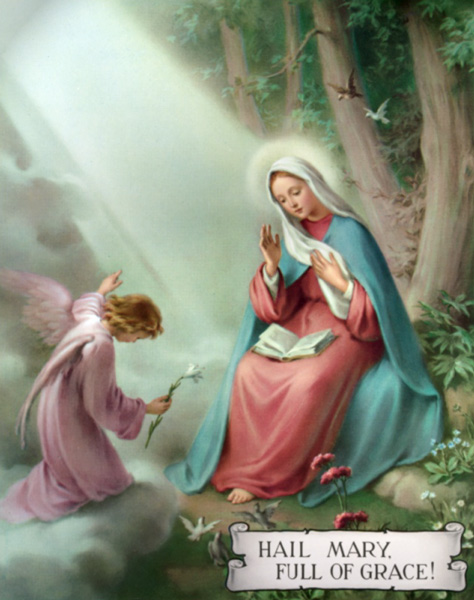


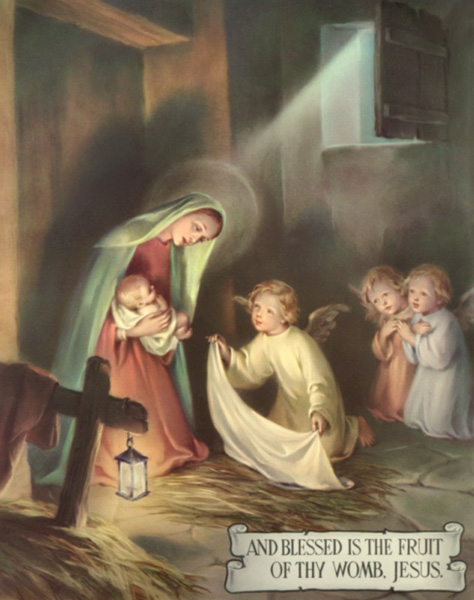


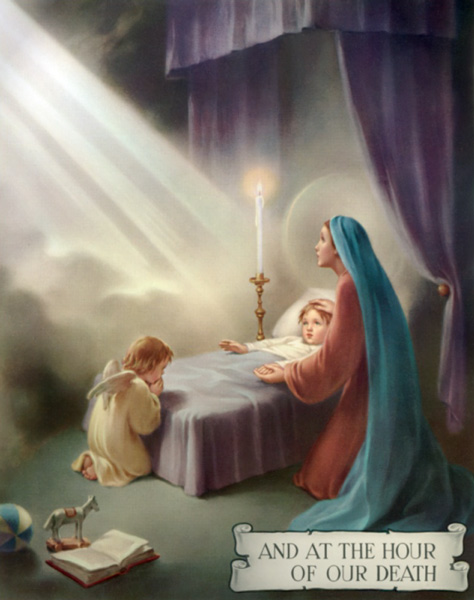
Tuesday, July 22, 2008
THE THREE HAIL MARYS DEVOTION- 23 July, St. Apollinaris
HEAVEN OPENED BY THE PRACTICE OF THE THREE HAIL MARYS
One of the greatest means of salvation, and one of the surest signs of predestination, is, unquestionably, the devotion to the Most Blessed Virgin. All the holy doctors of the Church are unanimous in saying with St. Alphonsus of Ligouri: "A devout servant of Mary shal
 l never perish."
[ St. Alphonsus Liguori ]
The chief thing is to preserve faithfully till death in this devotion.
Can there be an easier or more adaptable practice for all than the recitation each day of three Hail Marys in honour of the privileges conferred by the AdorableTrinity on the Blessed Virgin?

One of the first to say the three Hail Marys and to recommend them to others was the illustrious St. Anthony of Padua. His special aim in this practice was to honour the spotless Virginity of Mary and to preserve a perfect purity of mind, heart and body in the midst of the dangers of the world. Many, like him, have felt its salutary effects.
[ St. Anthony of Padua ]
Later on, St. Leonard of Port-Maurice, the celebrated missionary, had the three Hail Marys recited morning and evening in honour of Mary Immaculate, to obtain the grace of avoiding all mortal sins during the day or night; moreover, he promised in a special manner eternal salvation to all those who proved constantly faithful to this practice.

[ St. Leonard of Port -Maurice]
After the example of those two great Franciscan Saints, St. Alphonsus of Ligouri adopted this pious practice and gave it his most ardent and powerful support. He counselled its use and even imposed it as a penance on those who had not adopted this good habit.
The holy Doctor exhorts, in particular, parents and confessors to watch carefully that children be faithful in reciting each day their three Hail Marys, morning and evening. Or rather, like St. Leonard of Port-Maurice, he earnestly recommends it to all, "to the devout and to sinners, to the young and old."
Even persons consecrated to God will derive from this practice much precious and salutary fruit. Numerous examples may show how ageeable the Three Hail Marys are to the Divine Mother and what special graces they draw, during life and at the hour of death, on those who never omit them for a single day.

This practice has been revealed to St. Melchtilde (XIII century) with the promise of a good death, if she was faithful to it every day.
[ St. Melchtilde]
It is written, also, in St. Gertrude's revelations: "While this Saint sang the Hail
 Mary, at the matins of the Annunciation, she suddenly saw spring out of the Father and the Son, and of the Holy Ghost, three bright flames which penetrated the Heart of the Holy Virgin." Then she heard the following words: " After the Power of the Father, the Wisdom of the Son and the merciful Tenderness of the Holy Ghost, nothing approaches the Power, the Wisdom and the merciful Tenderness of Mary."
[ St. Gertrude the Great ]
His Holiness
 Benedict XV has raised the Confraternity of the Three Hail Marys to an Archconfraternity by according it precious indulgences with the power to aggregate to itself all Confraternities of the same kind, and to communicate them its own indulgences.
[ Pope Benedict XV ]
PRACTICE:
Recite, morning and evening, three Hail Marys in honour of the three great privileges, with this invocation at the end: for the morning: " O my Mother, preserve me from mortal sin during this day," for the evening: "O my Mother, preserve me from mortal sin during this night."

[ Leo XIII celebrating Mass ]
(Indulgences of 200 days granted by Pope Leo XIII, 300 days for the members of the Archconfraternity of the Three Hail Marys by Benedict XV, and Apostolic Benediction by Pius X.)
Wednesday, July 16, 2008
HERESIES OF VATICAN II - July 17, St. Alexius
HERESIES OF VATICAN II
Vatican II was a non- catholic heretical council called by Antipope John XXIII and took place between 1962 and 1965. It was solemnly promulgated and confirmed by Antipope Paul VI, on Dec. 8, 1965 ( inspite of what many of the defenders of Vatican II say).
However, it was not a true general or ecumenical council of the Catholic Church, because it was called and confirmed by manifest heretics ( John XXIII and Paul VI ) who were not eligible for papal election ( already discussed in earlier articles).
Remember, that as already discussed, Pope Eugene IV at the Council of Florence in his Bull Cantate Domino, 1442, ex cathedra," condemned , rejected , anathematised and declared all to be outside the Catholic Church who he
 ld contrary or opposing views to that held by the Catholic Church."
[ Pope Eugene IV ]We will look at five documents of Vatican II, to show that Vatican II is totally opposed to the teachings of the Catholic Church, and don't forget, that as we showed in our very first article in "Execrabilis", Vatican II was shot down even before it was launched!
1. Decree on Ecumenism, " Unitatis Redintegratio".
Jesus Christ founded a visible Church, of which He Himself is the Head, "One Lord, one faith, one baptism, one God and Father of all." says St. Paul in his epistle to the Ephesians ( 4: 5).
This Church is the sign among the nations ; she is the temple of the living God, the spouse of the slaughtered Lamb, the new Jerusalem. The Church is assisted by God in her life, in her teaching, in her worship, in her government and she has not the mission to involve herself with other religions for a better social world, for progress on earth, for better culture or whatever.
The mission of the Church is described by the words of Our Lord just before His Ascension: "Go ye into the whole world and preach the gospel to every creature, to all nations, make every man a disciple, teaching them to observe all things whatsoever I have commanded you and baptise them. He that believeth shall be saved : but he that believeth not shall be condemned." ( Mt 28: 19-20, Mk 16 : 15-16)
The Decree on Ecumenism of the Second Vatican Council gives us a very different understanding of the Church, of Her divine mission and of her relations with other religions. First of all it speaks of different churches.
It is quite clear that before Vatican II the idea of different Churches meant the different local churches around the bishop and his clergy: viz. the church of Cologne, the church of Paris, the church of Dublin, the church of Westminister or the church of Rome, the church of Sydney or the church of New York, San Francisco or Auckland, surrounded by his flock.
This notion of 'Churches' in the plural, was never used and applied to other denominations.
The Second Vatican Council endorsed the new meaning of this expression saying:
" It follows that these separated Churches and Communities, though we believe they suffer from defects already mentioned, have by no means been deprived of significance and importance in the mystery of salvation. For the Spirit of Christ has not refrained from using them as a means of salvation which derive their efficacy from the very fullness of grace and truth entrusted to the Catholic Church."#3
Now this is one of Vatican II'S worst heresies. It constitutes a rejection of the dogma, Outside The Catholic Church There Is No Salvation.
Pope Eugene IV, Council of Florence, "Cantate Domin0, " 1441, ex cathedra:
"The Holy Roman Church firmly believes, professes and preaches that all those who are outside the Catholic Church, not only pagans but also Jews or heretics and schismatics, cannot share in eternal life and will go into the everlasting fire which was prepared for the devil and his angels, unless they are they are joined to the Church before the end of their lives..."
2. Lumen Gentium...Decree on the Church
Concerning the Church itself, there is one word that in this text , which is perhaps the most harmful word in the whole Council documents.
In the Latin text, , it is: " Ecclesia Dei subsistit in Ecclesia Catholica" #8. This means ' the Church of God subsists or takes its concrete form, is realised ' in the Catholic Church'.
The truth of the matter is that. The whole truth is: 'Ecclesia Dei est Ecclesia Catholica - the Church of God is the Catholic Church'. If you say that the Church of God subsists in the Catholic Church, you mean that there are two different entities: the Church of God and the Catholic C
 hurch and it is quite by chance that these two entities come together.
Here is what the Vatican II council has to say on this:
"This Church, constituted and organised in the world as a society, subsists in the Catholic Church, which is governed by the successor of Peter and by the bishops in union with that successor, although many elements of santification and of truth can be found outside of her visible structure." #8
[ Like what?]
[ Sts. Peter and Paul ]St. Paul says that the people will lose the love for the truth and for that reason God will send them operation of error by which they will be deceived ( 2Thess. 2: 10). This is exactly what is happening in our days of the Great Apostasy.
3. Decree on Non- Christian religions: "Nostra Aetate"
The teaching that all religions are good and praiseworthy and are a means of salvation...
The decree on Non - Christian religions praises Jews, Muslims, Hinduism, Buddhism, all of which are absolutely contrary to the Catholic relig
 ion.
ion.In fact you will find that, not only do these non-Christian religions fail to lead to salvation but, very often, are obstacles to finding the truth, systems of resistance to the Holy Ghost. Very often, they have such a hold on their members, that they hinder them to leave. Take for example a Moslem. It is very difficult to convert him. He is completely held by his system, by his surroundings, by his clan, by his Islamic state. It is much easier to convert a pagan in the bush.
[ Antipope John Paul II kisses the Koran; the devil's handbook]
"Upon the Moslems, too, the Church looks with esteem...They adore the one God...though they do not acknowledge Jesus as God they revere Him as a prophet....In addition they await the day of judgement when God will give each man his due....and give worship to God especially through prayer, almsgiving and fasting." #3 "Nostra Aetate"
The Catholic Church teaches to the contrary:
Pope Pius XI, Mortalium Animos (#2), Jan, 6 1928:
"...that false opinion which considers all religions more or less good and praiseworthy,... Not only are those who hold this opinion in error and deceived , but also in distorting the idea of true religion they reject it, and little by little, turn aside to naturalism and atheism...from which it clearly follows that one who supports those who hold on these theories and attempt to realise them , is altogether abandoning the divinely revealed religion."
4. Dignitatis Humanae - Declaration on Religious liberty
Vatican II's declaration on religious liberty was without question the most notorious of all the documents of Vat II. This was because its teachings on religious liberty was so heretical that even the most liberal heretics had trouble rationalizing it.
Dignitatis humanae #2
"This Vatican synod declares that the human person has a right to religious freedom...all should have such immunity from coersion by individuals or by groups or by any human power...no one should be forced to act against his conscience in religious matters, whether in private or public, within due limits."
It is a dogma of the Catholic Church that states have a right to, and indeed a duty to prevent false religions from publicly propagating and practising their false religions. States must do this to protect the common good- the good of souls , which is harmed by public dissemination of evil.
That is why the Catholic Church has always taught that Catholicism should be the only religion of the state, and the state should exclude and forbid the public profession and propagation of any other.
It is abundantly clear that Vatican II is direct heresy against the infallible teaching of Pope Pius IX in his Syllabus of Errors, Dec,8 1864, #77
"In this age of ours it is no longer expedient that the Catholic religion should be the only religion of the state, to the exclusion of all other cults whatsoever."- Condemned.
5. Gaudium et Spes- Decree on the Church in the Modern World
Cardinal Ratzinger himself called this decree of the Council, "Gaudium et Spes", an anti - Syllabus.
" May the faithful, therefore, live in very close union with the men of their time. Let them strive to understand perfectly their way of thinking and feeling as expressed in their culture. Let them blend modern science and its theories and the understanding of the most recent discoveries with christian morality and doctrine....Thus their religious practice and morality can keep pace with their scientific knowledge and with an ever - advancing technology..." #62 Gaudium et Spes
The Syllabus of Errors is a collection of false sentences, of false statements or errors condemned under the pontificate of Pope Pius IX
The last of these sentences, the eightieth, states the following:
"The Roman pontiff can and must reconcile himself with human progress, with liberalism and with modern and human culture." - condemned

Antipopes Paul VI and John Paul II carry the symbol of the "Broken Cross"... Paul VI confirmed and promulgated the heretical Second Vatican Council, while his successor continued to implement its objectives for 25 years
Subscribe to:
Posts (Atom)